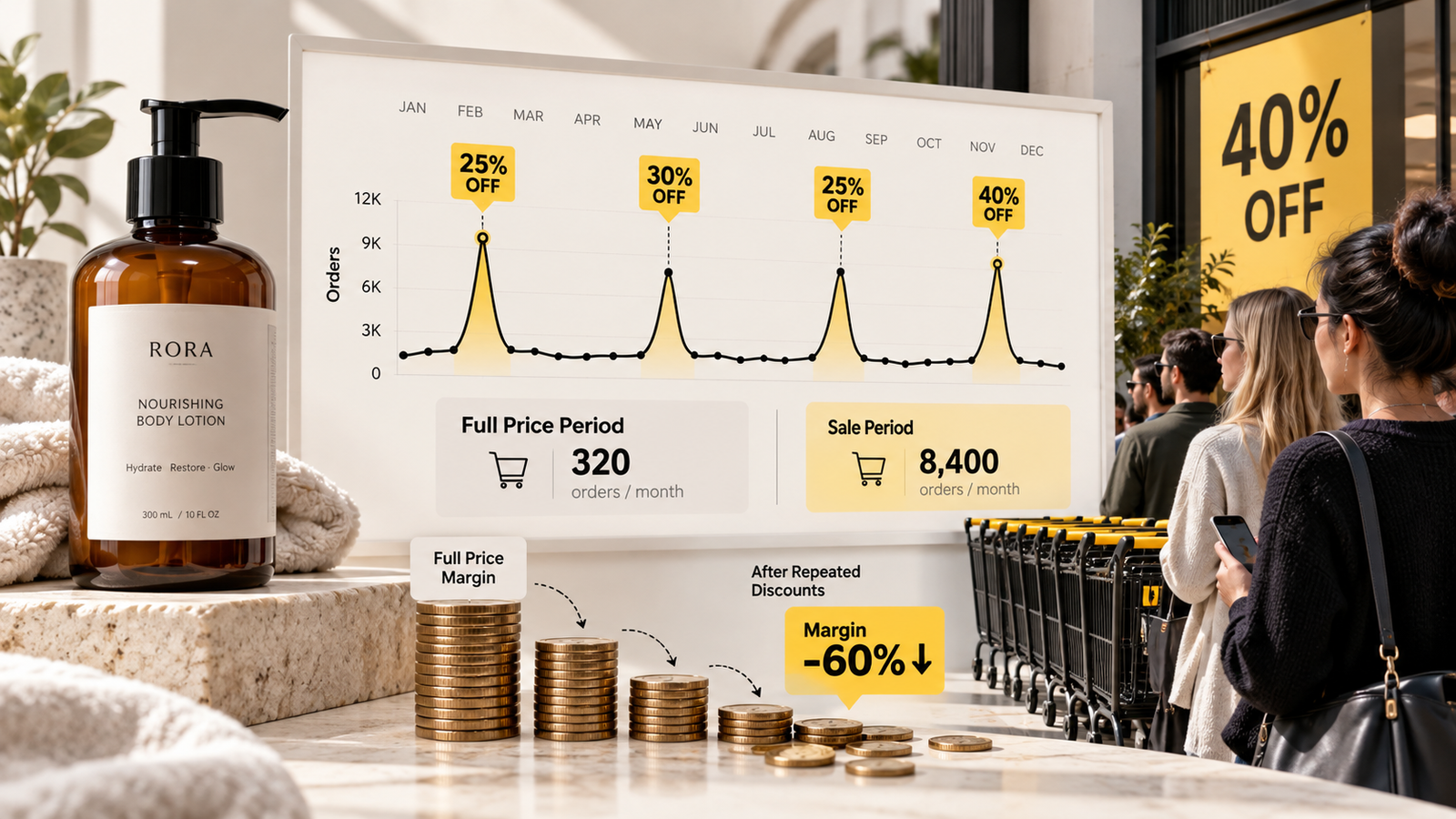
- Discount dependency is when a meaningful share of customers only buy during promotions. It shows up as revenue concentrated in sale weeks, sales dips before known events, and repeat buyers who never pay full price.
- The best single test: what share of repeat revenue comes from orders with no discount? If it keeps falling, your promotions are replacing purchases, not adding them.
- Discounts do not only cost margin on the website. A deep DTC sale can hurt your Amazon listing, your reference prices and your wholesale partners.
- Discounts, gifts with purchase and loyalty points are taxed and reported differently. The cheapest-looking incentive is not always the cheapest one.
- Reducing dependency works best gradually: fewer sitewide events, targeted offers for lapsed customers, and value added instead of price taken away.
In this article
A home goods founder counts her sales for the year: eleven. Spring sale, Mother's Day, a summer clear-out, anniversary week, Labor Day, two flash sales, Black Friday, Cyber Monday, a December gift event and an end-of-year sale. Each one hit its target. Each one felt like a win. And yet margin is lower than two years ago, full-price weeks feel slower every quarter, and her best customers seem to buy only when an email says "25% off".
When we plotted her weekly revenue with the sale dates marked, the pattern was impossible to miss. Before almost every event, sales dipped. Her customers had learned the calendar. They were not buying less. They were waiting.
Every sitewide sale works. That is the problem. Revenue spikes, the team celebrates, and the true cost stays out of sight: the customers who would have paid full price next week, the regulars who now wait for the next code, and the margin that never comes back.
This article shows how to measure discount dependency in your own order data, the cross-channel and tax effects most founders miss, and a safe way to reduce it without a revenue cliff.
Five numbers that show it
| Number | How to calculate | Warning sign |
|---|---|---|
| Discounted order share | Orders with any discount / all orders | Rising for three or more quarters |
| Full-price repeat share | Repeat revenue from undiscounted orders / all repeat revenue | Falling year on year |
| Sale-only customers | Customers whose every order had a discount / customers with 2+ orders | More than roughly a third |
| Promo week concentration | Revenue in promotion weeks / annual revenue | Rising while the number of promo weeks stays the same |
| Pre-event dip | Sales in the 7 to 10 days before a known sale vs a normal week | A visible drop before each event |
The warning levels are working rules of thumb. Your own trend matters more than any single threshold.
Share of repeat revenue from orders with no discount, by quarter (illustrative)
The single best test of discount dependency. If it keeps falling, promotions are replacing purchases rather than adding them.
| Label | Full-price share of repeat revenue |
|---|---|
| Q1 | 68% |
| Q2 | 66% |
| Q3 | 63% |
| Q4 | 61% |
| Q5 | 57% |
| Q6 | 54% |
| Q7 | 52% |
| Q8 | 49% |
The pre-event dip is the clearest signal, and the one founders rarely check. If sales fall in the week before every Black Friday, anniversary sale or holiday event, customers already know the calendar. They are not buying less. They are waiting.
Weekly revenue indexed to a normal week = 100, with two sale events in weeks 4 and 9 (illustrative)
The dip before each sale and the dip after it are both part of what the sale cost.
| Label | Weekly revenue index |
|---|---|
| Wk 1 | 100 |
| Wk 2 | 101 |
| Wk 3 | 84 |
| Wk 4 (sale) | 235 |
| Wk 5 | 92 |
| Wk 6 | 97 |
| Wk 7 | 99 |
| Wk 8 | 81 |
| Wk 9 (sale) | 228 |
| Wk 10 | 90 |
Why discounts replace purchases instead of adding them
A promotion creates three kinds of orders:
- New demand: people who would not have bought at full price, including first-time customers. This is the part promotions are meant to buy.
- Pulled-forward demand: customers who would have bought in the next few weeks anyway. Total revenue for the quarter barely changes.
- Subsidised demand: customers who would have paid full price today and used the code because it was there. This is pure margin given away.
The more often you run promotions, the smaller the first bucket and the larger the other two. Your best customers are the fastest to learn the pattern, because they pay the most attention to your emails.
| Bucket | Share of event revenue | Revenue | Discount given |
|---|---|---|---|
| New demand | 30% | $30,000 | $7,500 |
| Pulled forward from the next 4 weeks | 40% | $40,000 | $10,000 |
| Would have bought at full price that week | 30% | $30,000 | $7,500 |
| Total | 100% | $100,000 | $25,000 |
Illustrative. At a 20% discount, the discount given equals 25% of the discounted revenue. Only the first row is new business. The other $17,500 of discount bought nothing extra.
Where $100K of revenue from a 20% off event really came from ($K, illustrative)
The $25K of discount was spread across all three buckets, but only the first one grew the business.
| Label | Event revenue |
|---|---|
| New demand | $30K |
| Pulled forward from the next 4 weeks | $40K |
| Would have bought at full price that week | $30K |
For how this plays out with first-time buyers specifically, see Is your welcome discount building customers or bargain hunters?
The cross-channel costs nobody puts in the promo plan
Amazon
If you sell on Amazon, your DTC price is visible to Amazon's pricing systems. Amazon generally expects your offer on Amazon to be competitive with prices elsewhere, and a noticeably lower price on your own site or another retailer can cost your listing the featured offer (the Buy Box). Separately, Amazon deals generally need to beat the item's own recent low price, so a string of deep DTC-driven price cuts makes the next Amazon deal harder to qualify for and cheaper when it runs.
Wholesale and retail partners
Retail buyers watch your website. A 30% off sitewide sale in the middle of their season undercuts the price they are asking for your product on their shelf. Expect markdown requests, or a smaller next order.
Your "compare at" prices
A strikethrough price only works if it was real. The FTC's Guides Against Deceptive Pricing say a former price should be one the item was openly and actively offered at for a reasonably substantial period. Some states go further: California, for example, restricts advertising a former price unless it was the prevailing price in the three months before the ad. Constant promotions make your full price look fictional, legally and in customers' minds.
Discount, gift or points: they are not the same cost
| Incentive | How it shows in your numbers | Sales tax (typical treatment) | What it trains customers to do |
|---|---|---|---|
| Percentage or dollar discount | Reduces revenue, so gross margin % falls | Store discounts usually reduce the taxable price | Wait for the next code |
| Free gift with purchase | Revenue unchanged; the gift's cost sits in cost of goods | Varies by state; some treat the gift as taxable use by the seller | Buy now to get the extra |
| Free shipping over a threshold | Shipping cost in fulfilment or marketing | Depends on whether shipping is taxable in the state | Add items to the basket |
| Loyalty points | Part of revenue is deferred until points are used or expire | Discount applied at redemption usually reduces the taxable price | Come back to you rather than a competitor |
| Third-party or manufacturer coupon | Reimbursed by the third party | Often taxed on the pre-coupon price | Depends on the partner |
General patterns only. Sales tax treatment differs by state and by how the offer is structured.
How to reduce dependency without a revenue cliff
- Cut sitewide events first, not targeted offers. Go from, say, ten sitewide sales a year to four, and keep them on a predictable calendar that your full-price customers do not need to watch.
- Aim offers at the right people. Lapsed customers (no order in 1.5 to 2 times your normal reorder window) and first-time buyers are where discounts most often create new demand. Your most loyal repeat buyers need them least.
- Replace price with value. Gifts with purchase, bundles, early access and limited editions give people a reason to buy now without resetting what they think the product is worth.
- Protect full-price weeks. Most weeks of the year should be genuinely normal, with no code in the inbox, not a gap between offers.
- Measure for two full quarters. Revenue can dip for a few weeks as customers adjust. Judge the change on full-price repeat share and contribution margin, not on the first month.
Illustrative cases
Eleven sales a year, and a dip before every one
- What the dashboard said
- Every sitewide sale beat its target. The team added more events each year.
- What was actually happening
- 61% of annual revenue came from 14 promotion weeks. Sales dropped about 25% in the week before each event. Only 28% of repeat revenue came from full-price orders, down from 47% two years earlier. Loyal customers had learned the calendar.
- Decision
- Stop Cut to four sitewide events a year, replace the rest with gift-with-purchase offers and early access for email subscribers, and use discounts only for lapsed customers.
The best sale in the calendar is often the one that taught your customers not to buy the rest of the year.
A 30% website sale cost the Amazon listing its Buy Box
- What the dashboard said
- A four-day 30% off DTC sale produced the best website week of the quarter.
- What was actually happening
- During the sale, the brand's top two Amazon listings lost the featured offer because the website price was well below the Amazon price. Amazon sales on those listings fell by more than the website gained. After the sale, the next Amazon deal had to be priced below the website sale price to qualify.
- Decision
- Fix Plan promotions across both channels together, exclude Amazon's top listings from deep sitewide discounts, and use a gift with purchase on the website instead.
If you sell in more than one place, a price change in one channel is a price change in all of them.
What to do this week
- Calculate discounted order share and full-price repeat share for each of the last eight quarters.
- Tag your customers as full-price only, mixed or sale-only.
- Plot weekly revenue with promotion dates marked and look for pre-event dips.
- List every sitewide promotion planned for the next six months and cut the weakest third.
- If you sell on Amazon or wholesale, check what each promotion does to those channels before it runs.
- Ask your CPA how your discounts, gifts and loyalty points are treated for sales tax and revenue.
Questions founders ask
How do I know if I am discounting too much?
Look at the trend in full-price repeat share and at sales in the week before each promotion. If full-price repeat share is falling and sales dip before known events, customers are waiting for offers. Discounted order share rising for several quarters is another clear sign.
Is free shipping better than a discount?
Often, because it rewards a bigger basket rather than cutting the price of the product, and it does not reset your reference price. It still has a real cost, so set the threshold using your order value distribution and shipping costs rather than copying competitors.
How do I raise prices without losing customers?
Raise prices on new products or new customers first, keep existing subscribers on their current price for a period, and explain what changed if costs went up. Measure conversion and repeat rate for at least two quarters before judging the result.
Do discounts reduce sales tax?
A discount you give as the seller usually reduces the taxable sale price. Coupons reimbursed by a third party are often taxed on the price before the coupon. Rules vary by state, so confirm with your tax provider.
Can a DTC sale affect my Amazon sales?
Yes. A noticeably lower price on your own website can cost your Amazon listing the featured offer, and frequent deep discounts make Amazon deals harder to qualify for. Plan promotions across channels together.
Sources
- Guides Against Deceptive Pricing, 16 CFR Part 233 (eCFR)
- California Business and Professions Code section 17501, former price advertising (California Legislative Information)
- Amazon external competitive pricing: why you lost the Buy Box (Sitruna)
- New York's algorithmic pricing disclosure law takes effect (Jones Day)