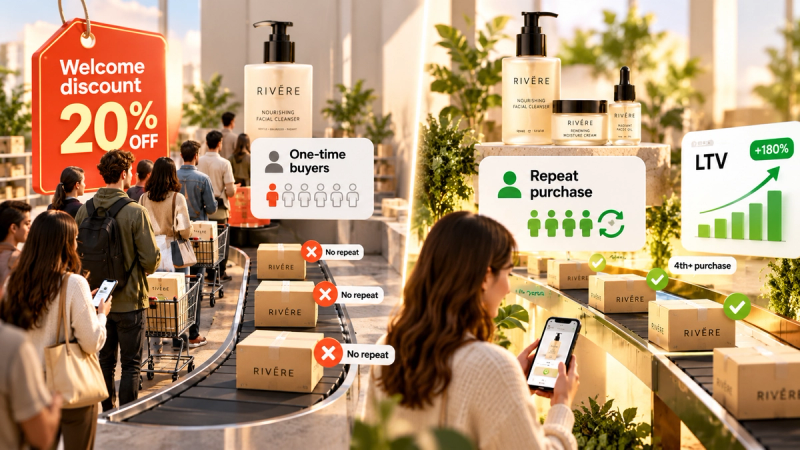
- A skincare brand at about $12K a month saw most first orders use its 20% welcome code, and assumed the code was working.
- When first orders were split by discount use and followed for 60 days, full-price buyers repeated at twice the rate of code buyers.
- Code buyers who did return mostly waited for the next promotion, so their repeat orders carried a second discount.
- The decision was to test a gift with purchase in place of the percentage code, judged on 60-day repeat and contribution per new customer, not first-order conversion.
- Academic research on acquisition discounts points the same way: deeper first-order discounts tend to produce customers with lower repeat rates.
In this case study
For a small skincare brand, the welcome pop-up was the most reliable thing on the site. "20% off your first order" captured emails, converted visitors and showed up in most first orders. When the founder looked at her discount report, the code was used on roughly two in three first purchases. Her conclusion was reasonable: the code works, keep it.
What she had not looked at was what happened next. When we followed the two groups for 60 days, customers who had paid full price on their first order came back at twice the rate of customers who had used the code. And the code customers who did come back mostly arrived during the next sale.
| Category | Skincare, sold DTC on Shopify |
|---|---|
| Size | About $12K a month in revenue |
| Acquisition | Meta prospecting and organic social, with a 20% welcome code pop-up |
| The question | Why do so few customers come back for a second product? |
What the dashboards said
The pop-up tool reported a strong sign-up rate. Shopify's discount report showed the code in most first orders. Conversion rate on the site was healthy. By every measure taken on the day of the first order, the code was a success. The problem was that every one of those measures was taken on the day of the first order.
How we connected the data
- Took every new customer from a six-month period that ended at least 60 days earlier.
- Split them by whether their first order used the welcome code, and checked both groups had bought similar entry products.
- Measured repeat rate at 30 and 60 days, the share of repeat orders that used another code, and 60-day contribution per customer.
What the connected data showed
Share of new customers who placed a second order, by days since first order (illustrative)
| Label | First order at full price | First order with the 20% code |
|---|---|---|
| Day 30 | 10% | 6% |
| Day 60 | 19% | 9.5% |
| Day 90 | 24% | 12% |
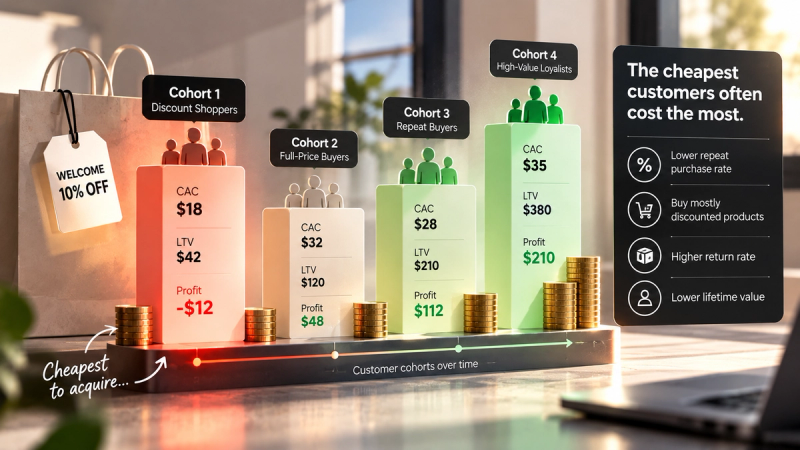
The code was not just discounting first orders. It was selecting a different kind of customer: people motivated by the deal more than the product. They bought once at 20% off, then waited for the next promotion. Meanwhile, the code was also being applied by people who would have paid full price anyway, which made every one of those first orders 20% less profitable for no gain.
This is consistent with research on acquisition promotions published in the Journal of Marketing Research, which found that deeper acquisition discounts were associated with lower repeat buying and lower long-term customer value.
Why it was missed
The code clearly lifted first orders, and that lift shows up immediately in every tool. The cost shows up 60 days later, as repeat orders that never happen, in a cohort report nobody was pulling. Nothing in the pop-up tool, the discount report or Ads Manager connects a first-order code to a customer's next two months.
The decision
| Decision | What it meant in practice |
|---|---|
| Test | Replace the 20% code with a gift with purchase that introduces the second product line, split 50/50 against the current code. |
| Fix | Switch to unique, single-use codes limited to customers with no previous orders, to stop leakage to coupon sites. |
| Fix | Judge the offer on 60-day repeat rate and contribution per new customer, not on pop-up sign-up or first-order conversion. |
How to check this in your own business
Split six months of new customers by whether they used a code on their first order, and compare 60 and 90-day repeat. The full method, plus five alternatives to test, is in our guide to welcome discounts. If promotions are driving most of your repeat orders too, read discount dependency. Or let a Blindspot Snapshot do it across every code and channel you run.
Questions founders ask
Do welcome discounts hurt customer lifetime value?
Often, but not always. The deeper the discount, the more it tends to attract price-motivated buyers who repeat less. Research on acquisition promotions found that customers acquired with a 35% discount were worth about half as much over time in one dataset. Test your own by comparing code and full-price cohorts.
Why does the effect take 60 days to show?
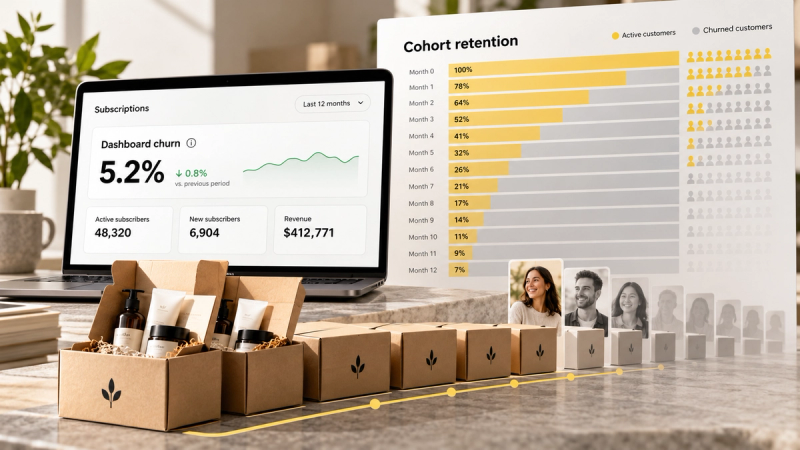
Because the cost of a welcome code is in the repeat orders that do not happen. You can only see a missing second order once enough time has passed for it to have happened. At 30 days the gap between cohorts is usually small; by 60 to 90 days it is clear.
What should replace a welcome discount?
The usual candidates are a gift with purchase, free shipping on the first order, or a discount on the second order. Test them against the current code with a traffic split and judge them on 60 to 90-day contribution per new customer.
Illustrative case: a composite built from patterns we see in brands at this stage, with details changed. It is not a single named client result.