- A frozen food subscription brand at about $40K a month sold boxes in three sizes. Ads for the smallest box had the lowest cost per acquisition, so budget kept moving there.
- Small-box subscribers were three times as likely to cancel after their first box as mid-size subscribers.
- Measured as cost per subscriber still active at month three, the small box was the most expensive customer to acquire and the mid-size box the cheapest.
- The decision: lead prospecting with the mid-size box, keep the small box as a checkout option, and scale on cost per retained subscriber at 90 days.
- Ads Manager optimises and reports on the first purchase. Cancellations live in the subscription app, which nobody was joining back to ad spend.
In this case study
The media buyer's weekly note was always the same: the small box ads have the lowest CPA in the account, so we are shifting more budget to them. It made sense on paper. A frozen food subscription brand selling boxes in three sizes, small, medium and large, and one of them was clearly cheapest to sell. Over a quarter, the small box went from a third of prospecting spend to most of it.
Sign-ups grew. Active subscribers did not. The operations team noticed it first: more first boxes going out, but the recurring order volume was barely moving. When we joined the subscription app's cancellation data back to the box each subscriber started on, the reason was obvious. Small-box subscribers were cancelling after their first box at three times the rate of everyone else.
| Category | Frozen food subscription |
|---|---|
| Size | About $40K a month in revenue |
| Offer | Small, medium and large boxes on a recurring schedule |
| The question | Why are active subscribers flat when sign-ups are growing? |
What the dashboards said
Ads Manager reported the small box at the lowest cost per purchase. The subscription app reported sign-ups up. Shopify reported more first orders. Each was accurate. None of them connected a sign-up to whether that subscriber was still around at box three.
What the connected data showed
| First box | CPA per sign-up | Cancelled after box 1 | Still active at month 3 | Cost per subscriber active at month 3 |
|---|---|---|---|---|
| Small | $32 | 45% | 38% | $84 |
| Medium | $41 | 15% | 72% | $57 |
| Large | $55 | 18% | 66% | $83 |
Cost per subscriber active at month 3 = CPA / share still active.
CPA per sign-up vs cost per subscriber still active at month 3, by first box (illustrative)
| Label | CPA per sign-up | Cost per subscriber active at month 3 |
|---|---|---|
| Small box | $32 | $84 |
| Medium box | $41 | $57 |
| Large box | $55 | $83 |
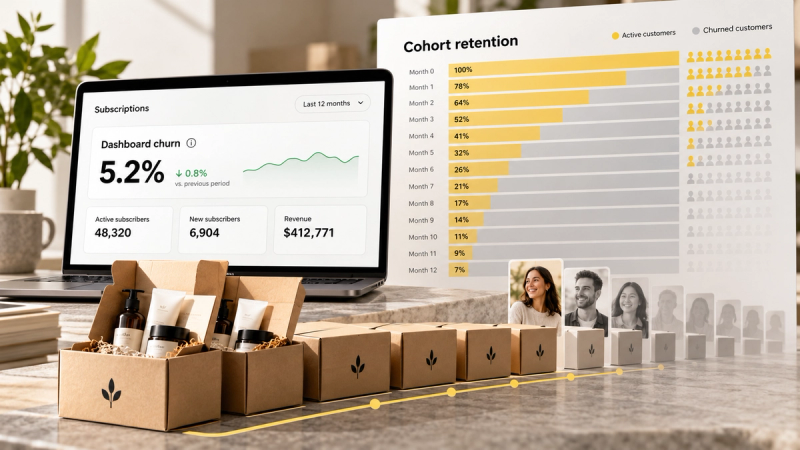
Share of each cohort still active, by month since sign-up (illustrative)
| Label | Medium box | Large box | Small box |
|---|---|---|---|
| Month 1 | 100% | 100% | 100% |
| Month 2 | 85% | 82% | 55% |
| Month 3 | 72% | 66% | 38% |
The small box was a low-commitment way to try the food, and many people used it exactly that way: one box, then cancel. The medium box asked for slightly more commitment and selected people who already intended to make it a habit. Measured on the outcome that matters for a subscription business, a subscriber who stays, the medium box was about a third cheaper than either alternative.
Why it was missed
Ads Manager optimises and reports on the first purchase. Cancellations live in the subscription app, which nobody was joining back to ad spend. So the platform kept finding more people who would buy one small box, and kept reporting a low CPA, and the media buyer kept doing exactly what the numbers told him to do. Blended monthly churn hid it too, because loyal subscribers from earlier cohorts kept the average steady.
The decision
| Decision | What it meant in practice |
|---|---|
| Scale | Lead prospecting ads with the medium box, in steps, while cost per retained subscriber holds. |
| Fix | Keep the small box as a checkout option, not an ad offer. |
| Fix | Track cost per retained subscriber at 90 days as the main scaling metric, next to ROAS. |
| Test | A box-two incentive for small-box subscribers, to see whether the second box can be rescued cheaply. |
How to check this in your own business
Group subscribers by their first box, plan or offer. Track the share still active after shipments one, two and three, then divide each group's acquisition cost by that share. Our guide to subscription churn by cohort shows how. Or let a Blindspot Snapshot join your ads, store and subscription data and give you the number for every offer you run.
Questions founders ask
What is cost per retained subscriber?
Acquisition cost divided by the share of new subscribers still active at a set point, usually after the second or third shipment or at 90 days. It shows the real cost of a subscriber who stays, rather than the cost of a sign-up.
Why would the cheapest box attract the worst subscribers?
The smallest box lowers the commitment, so it attracts people who want to try once. Many treat it as a single purchase rather than a subscription. Larger boxes ask for more commitment up front and select people who already intend to keep going.
Should the small box be removed?
Not necessarily. Keeping it as an option at checkout lets price-sensitive customers choose it, while ads lead with the box size that produces the best retained customers. The goal is to stop paying to promote the weakest entry point.
Illustrative case: a composite built from patterns we see in brands at this stage, with details changed. It is not a single named client result.