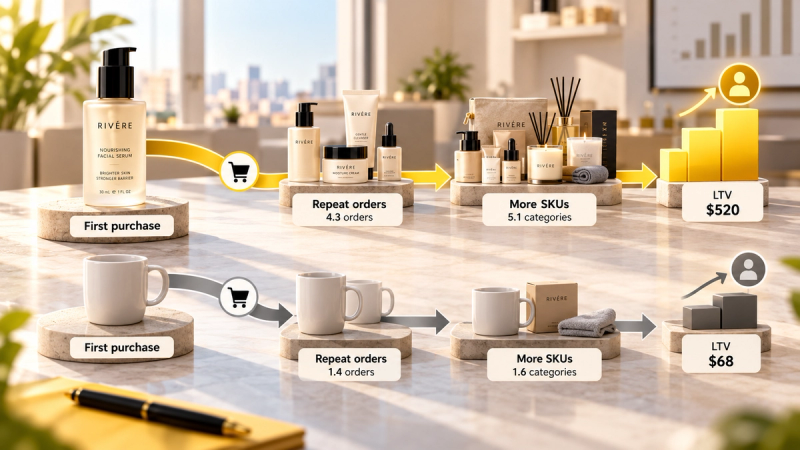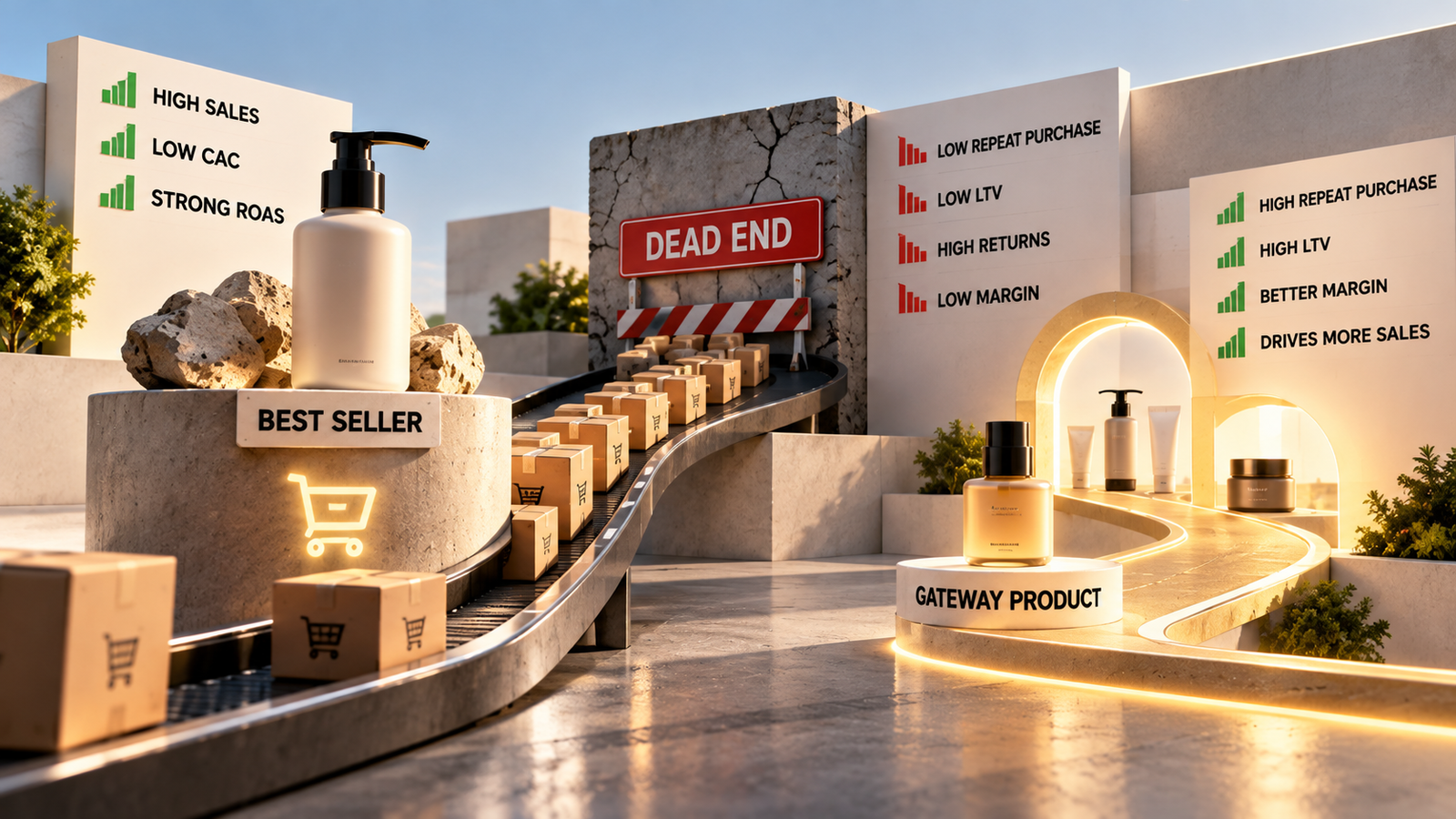
- Your gateway product is the first purchase that most often leads to a second order. It is rarely your best seller, and it often has the weakest first-order ROAS in the account.
- Many best sellers are made by ad budget, not by customers. The hero gets the most spend, so it wins the most first orders, so it tops the sales report, so it gets more spend. The loop never asks whether its buyers come back.
- Products that start a routine create the next order. Products that finish a problem create one order. That single idea predicts most gateway products before you even look at the data.
- Find yours by grouping customers by the product in their first order and comparing 90-day repeat, 180-day revenue and 180-day ROAS for each.
- Then build the offer around it: lead prospecting with the gateway, judge it on 60-day value, and pair the old hero with the product that leads somewhere.
In this article
The skincare team was about to cut the cleanser. Its ads had the weakest first-order ROAS in the account, under 1x, and the hero moisturiser was carrying most of the prospecting budget with numbers everyone liked. The cleanser was labelled "underperforming" in the weekly deck, and the plan was to switch it off.
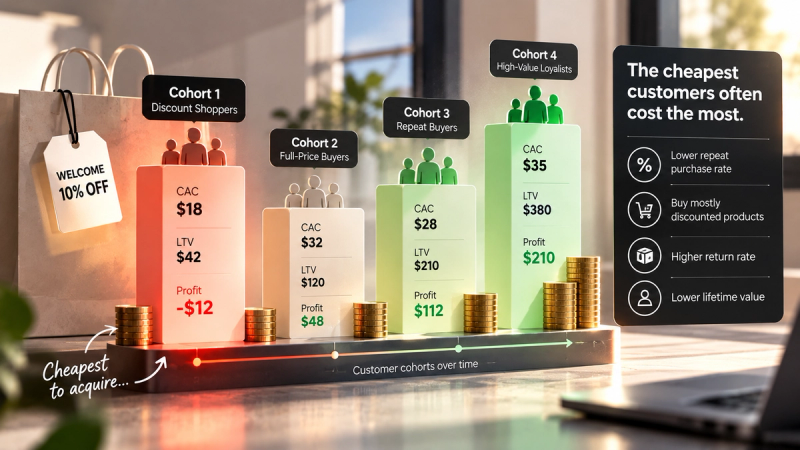
Then someone grouped six months of customers by the product in their first order. The cleanser's customers came back three times as often as the moisturiser's, and most of them came back to buy the moisturiser. At 180 days, they were worth 70% more. The product about to be cut was the brand's front door. The hero, on its own, was a door that closed behind the customer.
We see this in almost every catalog we look at. On the boards I sit on, the question I ask most is not "what's your ROAS?" It is "which customers came back, and what did they buy first?" Very few founders can answer it, and it is not their fault: the standard reports are not built to show it.
Why the best seller is so often a dead end
There is a loop in most ad accounts that nobody designed. The hero product gets the most budget, so it gets the most first orders, so it tops the sales report, so it gets more budget. At no point does the loop ask whether those buyers come back. Many best sellers are made by ad spend, not by customers.
The second pattern is about the product itself. Products that start a routine create the next order. Products that finish a problem create one. A single rich moisturiser solves the problem the customer came with. A cleanser starts a routine the customer now wants to complete. A starter kit introduces three products, and the customer comes back for whichever one they loved.
| Category | Likely routine starter (gateway) | Likely problem finisher (dead end) |
|---|---|---|
| Skincare | Cleanser, starter kit, travel-size routine | Single treatment cream, large-size hero |
| Supplements | Trial pack, single daily product with a 30-day supply | 90-day bundle, niche one-off formula |
| Coffee and food | Sampler, everyday staple | Gift box, limited edition |
| Pet | Daily chew or food topper | Novelty treat, toy |
| Apparel | Core basic in one great fit | Seasonal statement piece |
Hypotheses to test, not rules. Your own order data has the final word.
Founders know this question matters. A merchant with a large catalog asked the Shopify Community how to separate products customers buy once from products that keep them coming back. Another asked how to filter customers by their first product and was told the standard reports cannot do it. A US grooming brand reviewing a cohort app said the one feature that made it worth installing was segmenting customers by first-order product.
The case: the skincare brand whose hero was a dead end
Back to the skincare brand, with about 4,000 new customers over six months. Grouped by the product in each customer's first order, here is what the data showed. The figures are an illustrative composite.
| First product | Share of new customers | CAC | First order | First-order ROAS | 90-day repeat | 180-day revenue per customer | 180-day ROAS |
|---|---|---|---|---|---|---|---|
| Hero moisturiser | 55% | $28 | $48 | 1.71x | 12% | $61 | 2.18x |
| Cleanser | 20% | $36 | $34 | 0.94x | 38% | $104 | 2.89x |
| Starter kit | 10% | $40 | $55 | 1.38x | 45% | $146 | 3.65x |
Cleanser buyers most often bought the moisturiser next, at a median of 41 days. Starter kit buyers most often bought the serum, at a median of 33 days.
First-order ROAS vs 180-day ROAS by entry product (illustrative)
On day one, the hero looks best and the cleanser worst. At 180 days the order is reversed.
| Label | First-order ROAS | 180-day ROAS |
|---|---|---|
| Hero moisturiser | 1.71x | 2.18x |
| Cleanser | 0.94x | 2.89x |
| Starter kit | 1.38x | 3.65x |
On day one, the cleanser looked like the product to cut. At 180 days its customers were worth 70% more than the hero's, and starter kit customers were worth 140% more. 88% of hero buyers never came back at all.
Revenue per customer at 180 days, including the first order
| Label | 180-day revenue per customer |
|---|---|
| Starter kit | $146 |
| Cleanser | $104 |
| Hero moisturiser | $61 |
How to find your gateway product
- Export 12 months of orders with customer ID, date, line items and discount codes.
- Tag each customer's first-order product. For mixed first orders, use the highest-priced item or treat common combinations as their own group.
- Keep only customers whose first order is at least 90 days old, so everyone has had a fair chance to come back.
- For each first product, calculate 90-day repeat rate, 180-day revenue per customer and the most common second product.
- Add CAC from the ad sets promoting each product and calculate 180-day ROAS.
- Ignore any group with fewer than 100 first-time buyers. Small groups produce confident-looking noise.
For the full analytical method, including the product path table and allowable CAC by entry product, see our companion guide on customer value by first product. This article focuses on what to do once you know the answer.
Building your offer around the gateway
Knowing your gateway product only matters if the business changes how it sells. Here are the moves that usually follow, in order.
1. Lead prospecting with the gateway
Make the gateway the lead product in prospecting ads, with its own campaign or ad set and its own cost target. Since Meta's delivery now works out the audience largely from the creative, the product you show is the customer you get. Lead with a routine starter and you attract routine people.
2. Package it as an entry offer
If your gateway is a combination (cleanser plus moisturiser, a sampler, a trial pack), make it a named starter kit with a clear price. A good starter kit has three jobs: low enough risk for a stranger, enough variety to discover a favourite, and a clear next step to full size or subscription.
3. Fix the hero's journey instead of killing it
The hero still sells, and it still brings in volume. If most of its buyers never return, pair it with the product that leads somewhere: a cleanser offer in the day-30 email, a routine bundle on the product page, or a sample of the gateway in the box.
4. Time the reorder email to the data
The median days to second order is your post-purchase calendar. If cleanser buyers return at a median of 41 days, the reorder nudge belongs around day 30 to 35, featuring the product they most often buy next, not a generic bestseller list.
The KPIs that matter
| Metric | Formula | What it tells you |
|---|---|---|
| 90-day repeat by first product | Customers with a second order within 90 days / customers who started with the product | Which products create returning customers |
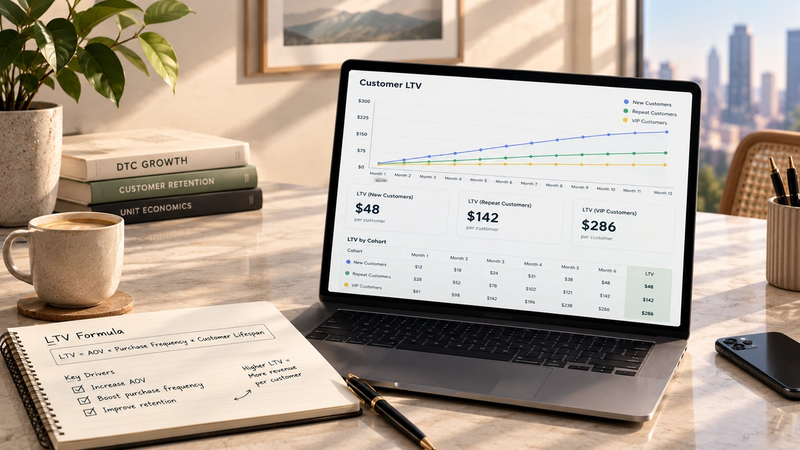
| 180-day revenue per customer | Cohort revenue in 180 days / customers in the cohort | What a starter is worth, not just its first order |
| 180-day ROAS by first product | 180-day revenue per customer / CAC | Which entry products deserve ad spend |
| Median days to second order | Median gap between first and second order | When to send the reorder email |
| Second-product map | Most common product on order two, per first product | Which product leads where |
The skincare brand whose hero was a dead end
- What the dashboard said
- The hero moisturiser had the best first-order ROAS and led the sales report. The cleanser was about to be cut for underperforming.
- What was actually happening
- Cleanser buyers reordered at 38% within 90 days, mostly buying the moisturiser next. Starter kit buyers reordered at 45%. Hero buyers reordered at 12%, and 88% never came back.
- Decision
- Scale Make the starter kit the lead prospecting offer, keep the cleanser's budget and judge it on 60-day revenue per customer, and add a cleanser pairing to the hero buyers' day-30 email.
Your best seller and your best starter are usually different products.
Key learnings
- Many best sellers are made by ad budget, not by customers.
- Products that start a routine beat products that finish one.
- Judge entry products on 60 to 180-day value, not day-one ROAS.
- Do not trust any group smaller than 100 customers.
Related reading: payback by channel and offer, and the pet treats case where 72% of hero buyers never reordered. If you want your own gateway products found from your order history, with CAC targets for each, that is part of every Blindspot Snapshot.
Questions founders ask
What is a gateway product in ecommerce?
A gateway product is the first purchase that most often leads a customer to buy again, usually a different product from the same brand. It is measured by repeat rate and revenue per customer over 90 to 180 days, not by how well it sells on its own.
What if a first order includes several products?
Tag the highest-priced item, or treat frequent combinations as their own group. Multi-product first orders usually repeat better than single-product ones, so keeping them separate stops them from flattering one product.
What is a good repeat rate for a gateway product?
Compare products within your own store rather than chasing an industry benchmark. The gap between your best and worst entry product is what drives the decision. In consumables, gaps of three to four times between the best and worst starter are common.
How much order history do I need?
Twelve months is ideal. Six months works for fast-reorder categories like supplements, coffee or pet food. Make sure every customer in the analysis has had at least 90 days to place a second order.
Does this work for products people don't reorder?
Yes. Measure whether customers buy a different product next. A mattress brand's gateway might be pillows; an apparel brand's might be one specific fit. The question is the same: which first purchase leads to a second one?