- More shoppers ask AI assistants what to buy. Those recommendations rarely show up as a click in your analytics, so most brands cannot see how often they are, or are not, mentioned.
- In-chat checkout has not taken off the way it was announced. OpenAI said in March 2026 that it was pulling back from Instant Checkout and focusing on discovery, with purchases sent to merchants' own sites.
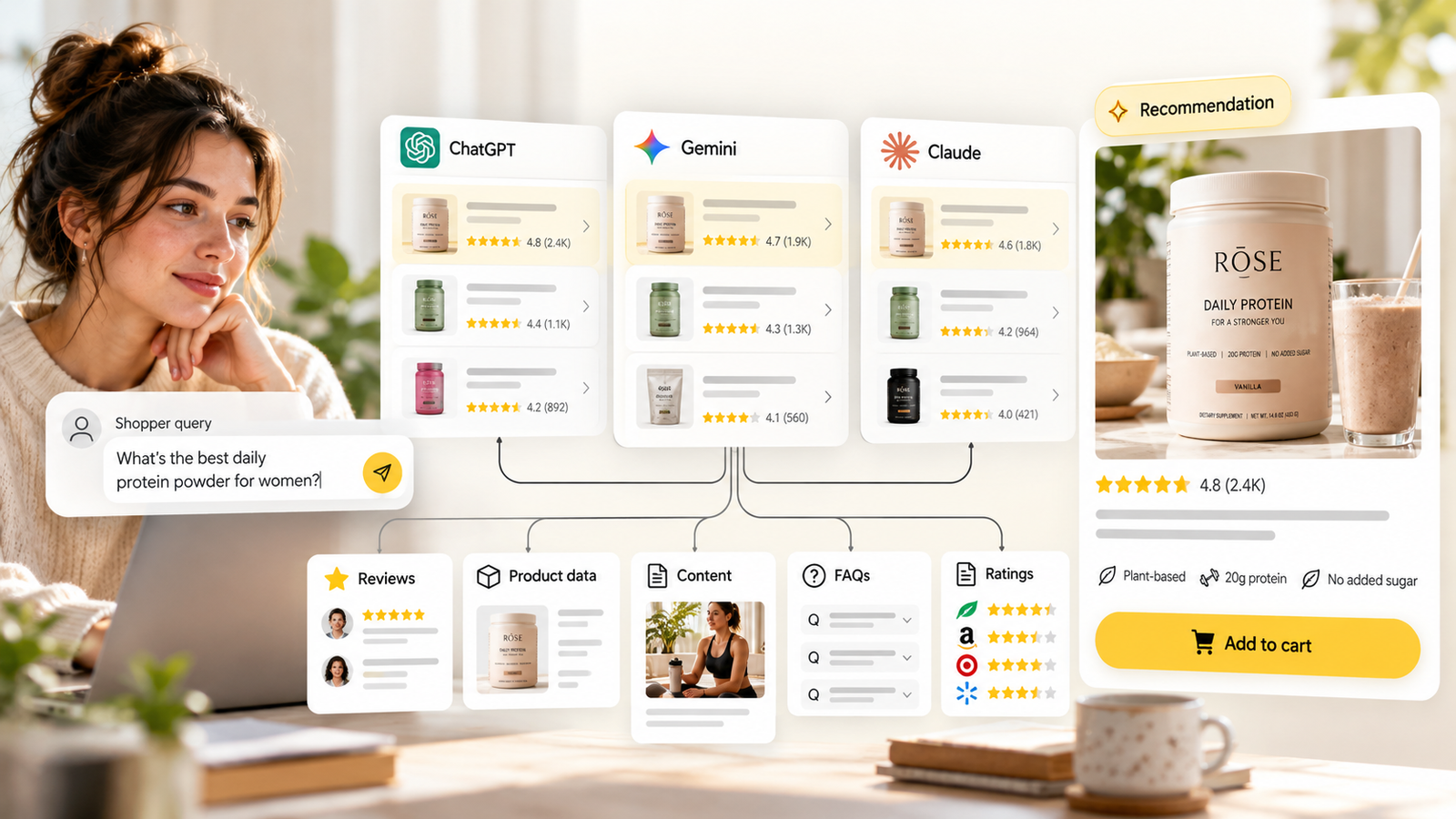
- Discovery is where the opportunity is. Assistants lean on clean product data, structured information on your site, reviews and independent mentions across the web.
- The practical work is unglamorous: an accurate product feed, complete schema, clear policies, real reviews, content that answers specific buyer questions, and presence where assistants look.
- Measure it with a post-purchase survey option for AI assistants and regular manual checks of what assistants say about your category.
In this article
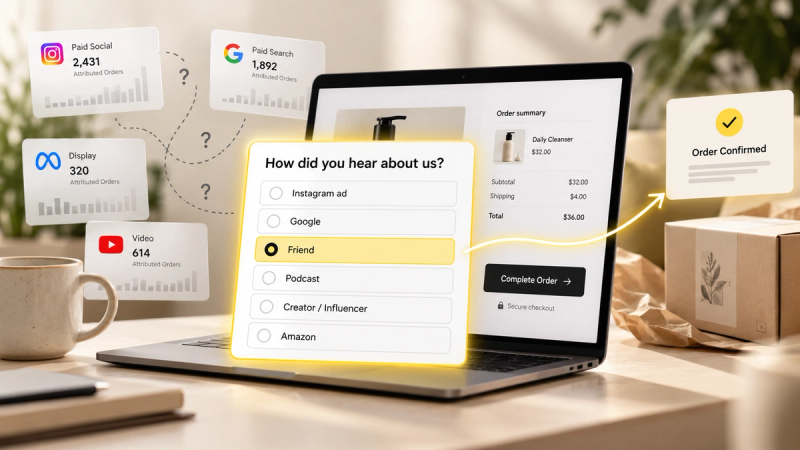
A founder added one new answer to her post-purchase survey in the spring: "An AI assistant (ChatGPT, Gemini, Claude or other)". She expected almost nobody to pick it. By the end of the summer, it was the source named by about one new customer in twenty-five, more than her podcast sponsorship. None of those orders showed an AI referral in GA4. They looked like direct traffic and branded search.
That is the strange position most brands are in. Shoppers are asking assistants "what is the best magnesium supplement for sleep" or "which running shoes are good for flat feet", and assistants are naming brands. Most of those recommendations never become a trackable click, so brands do not know whether they are being recommended, ignored, or described wrongly.
What actually happened with AI shopping in 2025 and 2026
| When | What happened | What it means for you |
|---|---|---|
| September 2025 | OpenAI and Stripe announced the Agentic Commerce Protocol and Instant Checkout inside ChatGPT, starting with US Etsy sellers | Buying inside an assistant became possible |
| January 2026 | Google announced the Universal Commerce Protocol, live in AI Mode and Gemini | A second standard for products in AI answers |
| February 2026 | Analysts counted only around 30 live Shopify merchants on Instant Checkout | In-chat checkout was slow to scale |
| March 2026 | OpenAI said it was pulling back from in-chat checkout to focus on discovery, with purchases on merchant sites | Discovery, not checkout, is where AI matters for most brands |
| 2026 | Shopify Agentic Storefronts, built on UCP, aims to make merchants discoverable across ChatGPT, AI Mode, Gemini and Copilot | A lower-effort route to appear across several assistants |
Source: Naturaily, August 2026, summarising announcements and analyst reports. Check each platform's current documentation, as this area changes quickly.
The lesson from the checkout pull-back is useful. Shoppers were happy to ask an assistant for advice, but many were uneasy handing it their payment details, and product data scraped from websites was often out of date on price and stock. Discovery stayed. Shoppers still ask assistants what to buy, then go to the brand's site or Amazon to buy it.
What assistants seem to rely on
No assistant publishes its full ranking method, and anyone who claims to know it exactly is guessing. But the inputs that matter are consistent with how these systems work and with what practitioners observe.
| Input | What it means | What to do |
|---|---|---|
| Product data | Accurate, current price, stock, variants, shipping and returns | Keep a live feed (Google Merchant Center, Shopify's channels), and remove discontinued products |
| Structured data on your site | Product, Offer, AggregateRating, FAQ and Organization schema | Make sure every product page has complete, valid schema; test it |
| Reviews | Volume, recency and specificity of reviews | Ask for reviews that mention use cases ("for sensitive skin", "after night shifts"), not just stars |
| Independent mentions | Editorial roundups, review sites, Reddit and forums, comparison articles | Earn coverage and honest discussion where your buyers ask questions |
| Content that answers specific questions | Clear, factual pages about who the product is for, ingredients, sizing, comparisons | Write for the questions buyers ask assistants, not for keywords alone |
The practical checklist
- Clean product feed: correct titles, descriptions, prices, stock, GTINs where you have them, shipping and return details. Connect Google Merchant Center if you have not.
- Complete schema on product pages, including review ratings, and clear shipping and returns policy pages.
- Check Shopify's AI and agentic channels for your plan and category, and enable what is available.
- Build a review engine that asks for specific, use-case reviews at the right moment after delivery.
- Publish answer pages for the ten questions your customer service team hears most, and comparison pages that are honest about who the product is not for.
- Earn independent mentions: product seeding to reviewers, PR for genuinely useful data or stories, and helpful participation in communities where your buyers ask for advice.
How to measure something you cannot click-track
Most AI-driven discovery arrives as direct or branded search traffic. Three signals together give a reasonable picture. The most reliable is an "AI assistant" option in your post-purchase survey. Second, referral traffic from assistant domains in GA4, which captures the minority of visits that do click through. Third, a monthly manual check: ask the main assistants the questions your buyers ask, and record whether you are named, how you are described, and who is named instead.
Share of new customers choosing "AI assistant" in a post-purchase survey (illustrative supplements brand)
Illustrative. Over the same period, GA4 recorded referrals from assistant domains on fewer than 1% of orders.
| Label | AI assistant share of survey answers |
|---|---|
| Apr | 1.2% |
| May | 1.8% |
| Jun | 2.3% |
| Jul | 2.9% |
| Aug | 3.4% |
| Sep | 4.1% |
Recommended for the wrong reason
- What the dashboard said
- AI assistants named the brand when asked about magnesium for sleep, and survey answers showed AI as a growing discovery source.
- What was actually happening
- Asked about magnesium for muscle cramps, the brand's strongest use case by reviews, assistants named three competitors instead. The product pages and reviews talked almost entirely about sleep.
- Decision
- Fix Add a clear use-case section to the product page, ask recent buyers for reviews describing their reason for buying, and publish an answer page comparing magnesium forms for cramps and sleep.
Assistants repeat what the web says about you. If your own pages do not say it, assume they will not either.
AI discovery is new, but the fundamentals are old: accurate product information, real reviews and genuinely useful content. A Blindspot Snapshot includes your survey and branded search data, so you can see how much of your growth is coming from places click-tracking cannot see.
Questions founders ask
How does ChatGPT decide which products to recommend?
OpenAI has not published a full ranking method. What practitioners see is that assistants draw on product data feeds, structured data on product pages, reviews, and how often and how favourably a brand is mentioned in sources they consider credible, such as review sites, editorial roundups and forums.
Can customers buy my products directly inside ChatGPT?
Instant Checkout launched in late 2025 with the Agentic Commerce Protocol, but adoption among Shopify merchants stayed small. In March 2026 OpenAI said it was pulling back on in-chat checkout and focusing on discovery, with purchases redirecting to the merchant's own site.
What are Shopify Agentic Storefronts?
A Shopify layer, built on Google's Universal Commerce Protocol, designed to let merchants appear for discovery across AI surfaces such as ChatGPT, Google AI Mode, Gemini and Microsoft Copilot without building each connection separately. Check Shopify's current documentation for eligibility.
How do I measure sales from AI assistants?
Add an "AI assistant" option to your post-purchase survey, watch referral traffic from assistant domains in GA4, and track branded search volume. Most AI-driven discovery shows up as direct or branded search, so the survey is the most reliable signal.