- Extra costs at checkout (shipping, tax, fees) are the top reason shoppers abandon carts, cited by 40% in Baymard Institute's research. Free shipping matters, but it is not free.
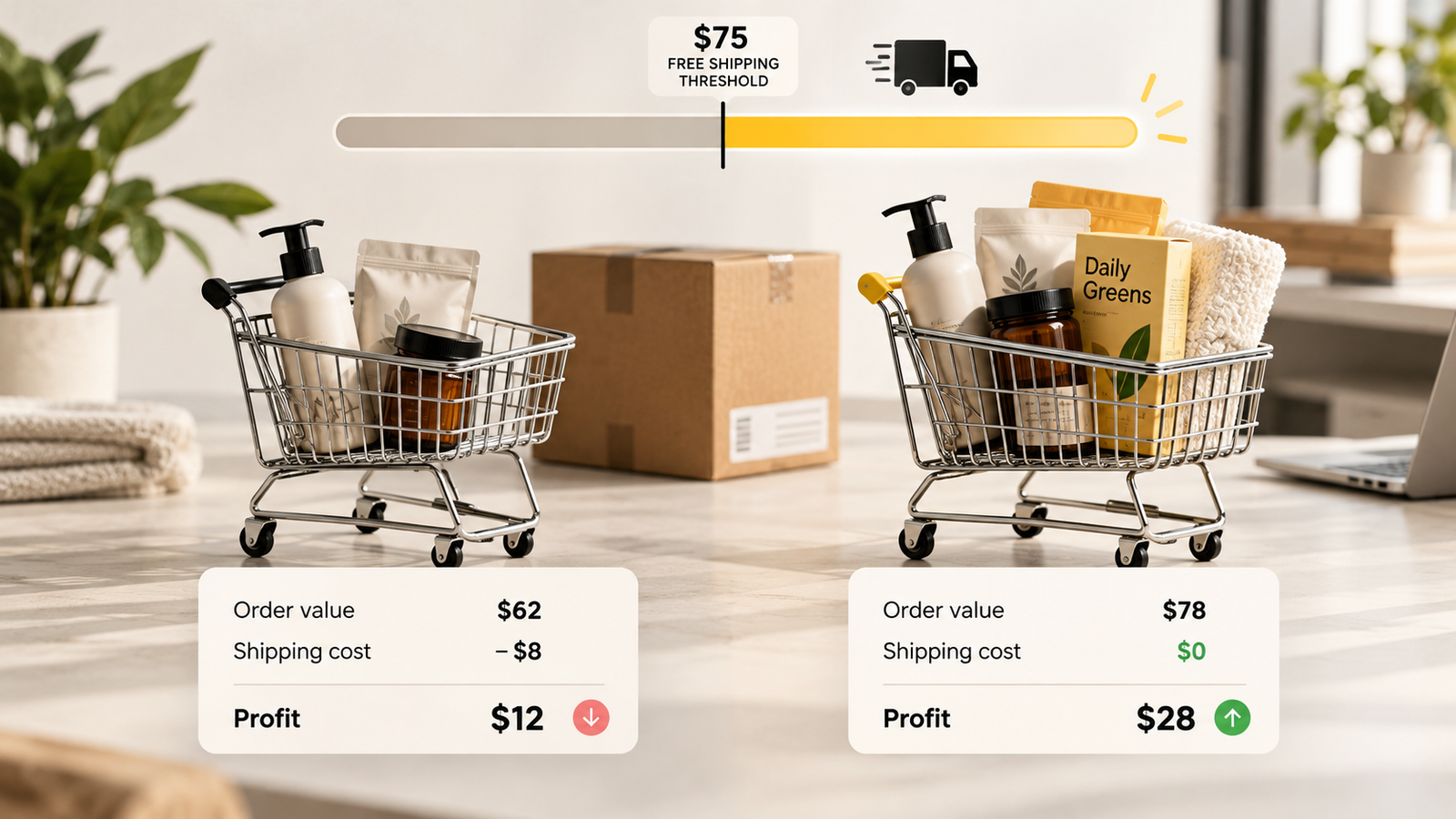
- The right threshold comes from your order value distribution: set it just above where a large cluster of orders already sits, so a small add-on moves them over.
- Judge the threshold on contribution per 1,000 sessions, not on AOV. A higher AOV with more subsidised shipping can earn less.
- Carrier costs rose again in 2026 (UPS and FedEx average increases of 5.9%, USPS Ground Advantage around 7% to 8%). A threshold set two years ago is probably too low now.
- In more than half of US states, shipping charges are generally taxable. How you charge for shipping changes what tax you collect and what customers see at checkout.
In this article
- Why shipping cost at checkout matters so much
- Step 1: know what an order really costs to ship
- Step 2: look at your order value distribution
- Step 3: model the options on contribution per 1,000 sessions
- Step 4: test it properly
- Things most brands miss
- Illustrative cases
- What to do this week
- Questions founders ask
Ask a founder where their free shipping threshold came from and the honest answer is usually "a competitor" or "it felt right". It was set at $49 two years ago, carrier rates have gone up twice since, and the hero product now costs $48. Almost every order clears the threshold with a single item, so the brand pays shipping on most of its orders and gets nothing in return: no bigger basket, no add-on, just a cost.
A free shipping threshold is one of the few levers that changes conversion rate, order value and margin at the same time. That makes it powerful, and it makes a badly set threshold quietly expensive. The right number does not come from competitors. It comes from three things in your own data: how your order values cluster, what shipping really costs you, and what is left after both.
The free shipping threshold is one of the few numbers that touches conversion rate, order value, margin, fulfilment costs and sales tax at once. It is usually set in an afternoon by looking at what three competitors do. Then it stays the same for years while carrier rates rise every January.
This article shows how to set it from your own data, how to test it, and the details most brands miss.
Why shipping cost at checkout matters so much
Baymard Institute's long-running checkout research puts average documented cart abandonment at about 70%. Among shoppers who were not just browsing, 40% said they left because extra costs such as shipping, taxes or fees were too high, the most common reason by a wide margin. Another 12% left because they could not see the total cost upfront.
The lesson is not "make shipping free". It is "never let shipping be a surprise, and make the threshold feel reachable".
Step 1: know what an order really costs to ship
Most brands know their average label cost. Few know the full cost by order size, destination zone and packaging.
| Input | Where to find it | Why it matters |
|---|---|---|
| Label cost by weight and zone | Carrier or 3PL invoices | Zone 8 can cost twice zone 2 for the same box |
| Residential and delivery area surcharges | Carrier invoice detail | Residential surcharges from UPS and FedEx sit in the mid-$6 range per package on many services |
| Dimensional weight | Box sizes vs carrier divisor | A light, bulky box is billed on size, not weight |
| Packaging and inserts | 3PL or supplier | Often $0.50 to $1.50 per order |
| Pick and pack per extra item | 3PL rate card | Bigger baskets cost more to pack |
| Returns shipping | Returns platform | If returns are free, part of their cost belongs here |
Carrier surcharge levels are indicative for 2026 and vary by contract.
Step 2: look at your order value distribution
Export 90 days of orders and group them into $5 or $10 bands. You are looking for clusters: order values where many customers naturally land because of your price points.
| Order value band | Share of orders | What is usually in it |
|---|---|---|
| Under $35 | 18% | One small item |
| $35 to $49 | 34% | One hero product |
| $50 to $64 | 21% | Hero plus a small add-on |
| $65 to $89 | 17% | Two main products or a bundle |
| $90 and above | 10% | Larger bundles, gifts |
Illustrative. The biggest cluster is one hero product at $35 to $49.
Share of orders by order value band (illustrative)
The best threshold usually sits just above the biggest cluster, so one add-on carries most orders over it.
| Label | Share of orders |
|---|---|
| Under $35 | 18% |
| $35 to $49 | 34% |
| $50 to $64 | 21% |
| $65 to $89 | 17% |
| $90 and above | 10% |
A good threshold usually sits a little above the largest cluster, so that customers in that cluster need a small add-on to qualify. Too close to the cluster and you give free shipping to people who would have paid anyway. Too far above and nobody bothers to reach it.
Step 3: model the options on contribution per 1,000 sessions
AOV is the number everyone watches, and it is the wrong one to decide with. Free shipping raises conversion and order value but also shifts shipping cost from the customer to you. The number that combines all of it is contribution per 1,000 sessions.
| Option | Conversion rate | AOV | Orders shipping free | Contribution per order | Contribution per 1,000 sessions |
|---|---|---|---|---|---|
| Flat $6.95 shipping, no threshold | 2.80% | $58 | 0% | $31.51 | $882 |
| Free over $49 | 3.10% | $61 | 62% | $29.06 | $901 |
| Free over $65 | 3.00% | $68 | 38% | $35.07 | $1,052 |
| Free over $90 | 2.85% | $60 | 12% | $31.92 | $910 |
| Free shipping on everything | 3.35% | $55 | 100% | $22.70 | $761 |
Illustrative. 62% gross margin, $8.40 average shipping cost, $3.00 pick, pack and payment fees, $6.95 flat fee paid on orders below the threshold.
Contribution per 1,000 sessions by shipping option (illustrative)
Free shipping on everything had the best conversion rate (3.35%) and the lowest contribution.
| Label | Contribution per 1,000 sessions |
|---|---|
| Flat $6.95 | $882 |
| Free over $49 | $901 |
| Free over $65 | $1,052 |
| Free over $90 | $910 |
| Free on everything | $761 |
Free shipping on everything has the highest conversion rate and the lowest profit. The $49 threshold, which matches the biggest cluster of orders, gives shipping away to customers who were already buying one hero product. The $65 threshold asks for one add-on and earns about 19% more contribution per 1,000 sessions than the flat fee option.
Step 4: test it properly
Change the threshold for a set period rather than switching back and forth, because customers who see different thresholds on different days get confused and complain.
- Run the current threshold for four weeks and record conversion rate, AOV, share of orders shipping free and contribution per 1,000 sessions.
- Change the threshold and run it for four to six weeks with no other major changes to offers or prices.
- Compare the same weeks last year to check for seasonal effects.
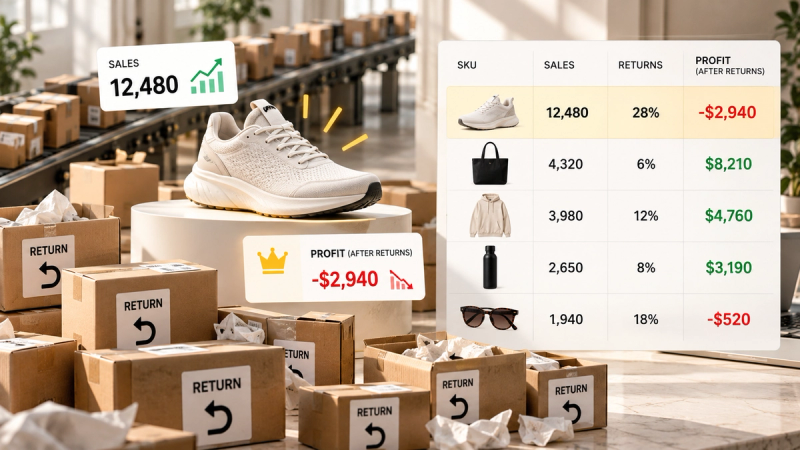
- Watch returns: thresholds that encourage filler items can raise return rates. We explain how returns change margin in Your best-selling product might be losing money after returns.
Things most brands miss
- Heavy or bulky SKUs can lose money on every free shipping order. Exclude them from the threshold, or charge a flat oversize fee.
- Far zones cost much more. If you ship everything from one coast, a second warehouse can cut shipping cost more than any threshold change.
- Subscriptions often ship free regardless of value. Check whether small subscription orders are covering their shipping.
- Free returns multiply the shipping cost. A free shipping and free returns policy on high-return products can mean paying for three shipments per kept item.
- Membership programmes (a yearly fee for free shipping) can work well for frequent buyers of consumables and reward the customers you most want to keep.
Illustrative cases
The threshold sat right on top of the hero product
- What the dashboard said
- Free shipping over $40 was converting well. AOV was $44.
- What was actually happening
- The hero product cost $42, so almost every single-product order qualified for free shipping. 71% of orders shipped free, and the shipping subsidy was about 11% of revenue. Almost no customers were adding a second item.
- Decision
- Fix Raise the threshold to $55, add two add-ons between $12 and $18 to the cart page, and keep free shipping for subscribers.
A threshold below your most common order value is not an incentive. It is a discount.
Free shipping on everything, including 18-pound orders to the other coast
- What the dashboard said
- Free shipping on all orders had lifted conversion. The monthly P&L looked tight but acceptable.
- What was actually happening
- Orders containing the two heaviest products shipped to the western states cost an average of $31 to deliver. Those orders had negative contribution before any ad spend, and they were 14% of volume.
- Decision
- Fix Add a flat oversize fee for the two heaviest products and test a West Coast 3PL for the top 20 SKUs.
Average shipping cost hides the orders that lose money. Split it by product weight and zone.
What to do this week
- Pull 90 days of orders into $5 order value bands and find your largest cluster.
- Get shipping cost per order by weight band and zone from carrier or 3PL invoices, including surcharges.
- Calculate contribution per 1,000 sessions for your current setup.
- Model two or three threshold options and pick one to test for four to six weeks.
- Check which SKUs lose money when shipped free, and exclude or re-price them.
- Ask your tax provider to confirm shipping and handling are set up as separate lines in your store.
Questions founders ask
What is a good free shipping threshold?
One set slightly above your largest cluster of order values, so customers need a small add-on to qualify. Many brands land somewhere 15% to 30% above their median order value, but your own distribution, margin and shipping cost decide the right number.
Does free shipping increase conversion?
Usually, yes. Extra costs at checkout are the most common reason for cart abandonment in Baymard Institute's research. Whether free shipping increases profit depends on your margin, shipping cost and how many orders already exceed the threshold.
Should I raise my free shipping threshold after carrier rate increases?
Review it every year after the January carrier increases. If your average shipping cost has risen and your threshold has not, your subsidy has grown. Test a higher threshold together with good add-on products rather than simply raising it.
Is shipping taxable in the US?
In more than half of states, shipping charges are generally taxable. Some states exempt shipping when it is separately stated and reflects actual cost. Handling charges are taxable in most states. Keep shipping and handling as separate lines in your store.
Is free shipping better than a discount code?
It often is, because it rewards larger orders instead of cutting the product price, and it does not lower your reference price. It still has a real cost, so measure it on contribution, not just conversion.