- The Supreme Court struck down the IEEPA tariffs on February 20, 2026. Replacement Section 122 tariffs expired on July 24, 2026, and new Section 301 duties on about 60 economies took effect the same day. Your costing sheet may reflect any of these regimes.
- Importers who paid IEEPA duties may be owed refunds. CBP began processing them through a new system, and the claim usually needs your customs broker.
- De minimis duty-free entry for low-value parcels is suspended indefinitely, and the law ends it permanently on July 1, 2027. Brands shipping direct from overseas warehouses need a new model.
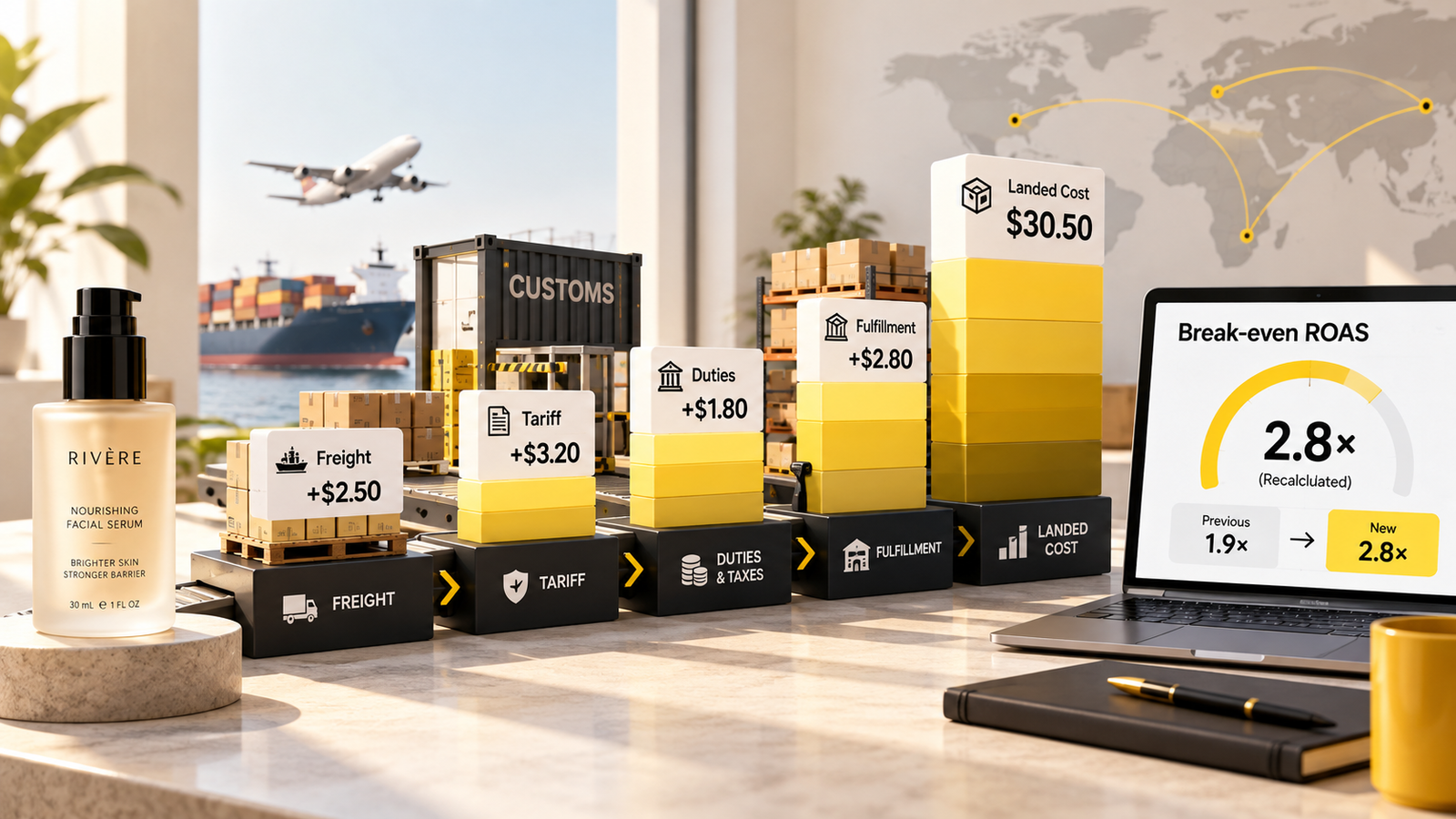
- Break-even ROAS moves most on products where landed cost is a large share of price. A 10-point duty change barely touches a 75% margin serum and can wipe out the ad budget for a 40% margin product.
- Duties are part of inventory cost for tax purposes, so they hit your P&L when goods sell, not when you pay them. A refund on duties you already expensed is generally taxable income.
In this article
A yoga accessories founder is about to place her autumn reorder. Her costing sheet says the mats from India land at $17.52 each, so her break-even ROAS on Meta is set high and the mats get only a small share of the ad budget. The sheet was built in 2025, when the duty on that product was over 50%. Since July 24, 2026, it has been closer to 15%. The real landed cost is about $13.72.
Her most profitable product has been starved of ad spend for months because of a number nobody updated. Meanwhile, another brand in the same co-working space has the opposite problem: a costing sheet that assumes duties ended with the February Supreme Court ruling, on products that now carry new Section 301 duties. Both are making ad decisions on the wrong margin. In 2026, landed cost is no longer a number you set once a year.
Most DTC brands set their ROAS targets once, from a costing sheet built when the supplier quote came in. Since early 2025, US import duties on consumer goods have changed four times: the IEEPA tariffs, the Supreme Court ruling that ended them, a temporary Section 122 tariff, and the Section 301 duties that replaced it in July 2026.
If your landed costs and ROAS targets were set at any point in that period, they are probably wrong. Sometimes too low, sometimes too high. Both are expensive: too low and you scale products that lose money, too high and you under-invest in products that could grow.
What changed, in order
| Date | What happened | What it means for you |
|---|---|---|
| August 29, 2025 | De minimis duty-free treatment for parcels under $800 suspended by executive order | Direct-to-consumer parcels from overseas became dutiable |
| February 20, 2026 | Supreme Court rules in Learning Resources v. Trump that IEEPA does not authorise tariffs | IEEPA duties end and refunds become possible |
| Late February 2026 | 10% Section 122 tariff imposed on most imports | A temporary replacement, legally limited to 150 days |
| May 7, 2026 | Court of International Trade finds the Section 122 tariffs exceeded the President's authority | Relief limited to the named plaintiffs while the appeal runs |
| June 24, 2026 | CBP makes the de minimis suspension indefinite by regulation | Low-value parcels stay dutiable under separate legal authority |
| July 24, 2026 | Section 122 expires; new Section 301 duties on about 60 economies take effect | The current regime for most consumer imports |
| July 1, 2027 | De minimis exemption ends by statute under the One Big Beautiful Bill Act | Permanent, whatever happens in the courts |
The Section 301 duties in effect since July 24, 2026
According to law firm summaries of the new duties, they fall into tiers. Goods from the EU and Taiwan face a combined duty of 10% including normal duties. Goods from Japan, Korea and Switzerland face a combined 12.5%. A group of economies including Canada, Mexico, India, the UK, Indonesia, Malaysia, Bangladesh and Pakistan face an additional 10% on top of normal duties, and another group including Vietnam, Thailand, the Philippines, Brazil and the UAE face an additional 12.5%. For China, the new 12.5% stacks on the existing 25% Section 301 duty, for about 37.5% combined on covered goods. Products already covered by Section 232 (such as steel, aluminium, copper, wood products and vehicles) are excluded from the new duties, as are goods qualifying under free trade agreements such as USMCA.
Step 1: rebuild landed cost per SKU
Allocate freight and fees per unit by volume or weight, not by value, otherwise light, expensive items carry costs that belong to heavy, cheap ones.
Step 2: compare the old sheet with today
| SKU and origin | Supplier price | Duty in old sheet | Duty now | Landed cost, old sheet | Landed cost now | Break-even ROAS, old | Break-even ROAS now |
|---|---|---|---|---|---|---|---|
| Serum, China | $6.00 | 45% | 37.5% | $10.02 | $9.57 | 1.78x | 1.75x |
| Hoodie, Vietnam | $14.00 | 36% | 28.5% | $21.09 | $20.04 | 1.84x | 1.79x |
| Yoga mat, India | $9.50 | 54.6% | 14.6% | $17.52 | $13.72 | 2.03x | 1.81x |
| Glass tumbler, EU | $7.00 | 15% | 10% | $9.67 | $9.32 | 2.14x | 2.10x |
Illustrative rates and costs, including normal duties. Break-even ROAS uses price divided by contribution after landed cost, fulfilment, payment fees and expected returns. Your products' rates depend on their HTS codes.
Landed cost per unit: sheet built on 2025 rates vs rates since July 24, 2026 (illustrative SKUs)
The direction and size of the change depend on origin and product. Confirm your own rates with your customs broker.
| Label | Old sheet | Now |
|---|---|---|
| Serum, China | $10.02 | $9.57 |
| Hoodie, Vietnam | $21.09 | $20.04 |
| Yoga mat, India | $17.52 | $13.72 |
| Glass tumbler, EU | $9.67 | $9.32 |
In this example, every product got cheaper to import after July 24, and the yoga mat's break-even ROAS fell from 2.0x to 1.8x. A brand still running the old targets would be under-spending on it. The opposite happens where a costing sheet was built on pre-2025 rates and never updated. The lesson is the same either way: rebuild the sheet from current rates.
Step 3: see where duty changes actually matter
Tariff changes hit hardest where landed cost is a large share of the selling price. For high-margin products the effect on break-even ROAS is small. For low-margin, heavy or cheaply priced products it can be the difference between scaling and stopping.
| Landed cost as share of price | Other costs per order | Break-even ROAS before | Break-even ROAS after |
|---|---|---|---|
| 15% | $25 | 1.67x | 1.71x |
| 30% | $25 | 2.22x | 2.38x |
| 45% | $25 | 3.33x | 3.92x |
Illustrative. The duty increase is 10% of the supplier price, applied to the landed cost share shown.
Break-even ROAS before and after a 10-point duty increase on a $100 product
| Label | Break-even before | Break-even after |
|---|---|---|
| Landed cost 15% of price | 1.67x | 1.71x |
| Landed cost 30% of price | 2.22x | 2.38x |
| Landed cost 45% of price | 3.33x | 3.92x |
Step 4: check the cash, not just the margin
Higher duties are paid when goods clear customs, often months before the goods sell. A 12.5% increase on a $200,000 production order is $25,000 of extra cash needed at the port. Many brands felt the tariff changes first in their bank balance, then in their margin.
Money you may be able to get back
IEEPA refunds
After the Supreme Court ruling, US Customs and Border Protection began returning IEEPA duties through a new system called CAPE (Consolidated Administration and Processing of Entries). The first phase covered roughly 82% of IEEPA entries, and the total at stake was reported at around $166 billion. If you were the importer of record on shipments that paid IEEPA duties, ask your broker which of your entries are covered and what you need to file. If a supplier or freight forwarder was the importer of record, the refund goes to them, and you will need to negotiate your share.
Duty drawback
If you export goods you imported, for example to Canadian or international customers from a US warehouse, you can often claim back up to 99% of the duties paid on them, going back up to five years. Section 301 duties are generally eligible; Section 232 duties and antidumping duties are not. Domestic returns do not qualify unless the goods are later exported or destroyed under the rules. The claim depends on matching imports to exports at the SKU level, so good records decide whether it is worth doing.
First sale valuation
If you buy through a trading company or agent that buys from the factory, you may be able to declare the lower price the middleman paid the factory as the customs value, which reduces duty. It needs a genuine sale at each step, goods clearly destined for the US at the time of the first sale, and documents from the middleman that many will be reluctant to share. For brands paying duty on large volumes from China or Vietnam through agents, it is often worth asking a customs lawyer.
Illustrative cases
The ROAS target was still built on last year's duties
- What the dashboard said
- The agency held a 2.4x ROAS target across the account, set in 2025 when the brand's costing sheet was last updated.
- What was actually happening
- After the July 2026 changes, landed cost on the India-made products fell by about a fifth. Their break-even ROAS dropped from roughly 2.1x to 1.8x, so the account was cutting spend on products that were now comfortably profitable at 2.0x. The Vietnam-made hoodies moved less.
- Decision
- Scale Rebuild the costing sheet from current rates, set break-even ROAS by SKU group, and raise spend on the India-made range while keeping the 2.4x target on lower-margin lines.
Tariff changes can make targets too strict as well as too loose. Update the sheet every time the rates change.
Parcels from overseas stopped working, and refunds were sitting unclaimed
- What the dashboard said
- Delivery times grew and customer complaints about unexpected charges rose after de minimis was suspended.
- What was actually happening
- Every parcel now needed its own customs entry and paid duty. Moving to bulk ocean shipments into a US 3PL cut the duty and fees per unit and brought delivery back to three to five days. Separately, the brand had paid IEEPA duties on two bulk shipments in 2025 that no one had claimed back because the freight forwarder was the importer of record.
- Decision
- Fix Switch to bulk import into a US 3PL, become importer of record with its own broker, and work with the forwarder to file for the IEEPA refund on the 2025 entries.
The de minimis change is permanent. Build the supply chain for it now, and check who is holding your refunds.
What to do this week
- List your top 30 SKUs with HTS code, country of origin and supplier price, and ask your broker to confirm current duty rates.
- Rebuild landed cost per unit, allocating freight and fees by weight or volume.
- Recalculate contribution margin and break-even ROAS for each SKU, and update the targets your ad account uses.
- Find the SKUs where break-even ROAS moved most and decide whether to reprice, resource or stop advertising them.
- Ask your broker which of your 2025 and early 2026 entries are eligible for IEEPA refunds.
- If you export, check whether duty drawback is worth claiming.
- Tell your CPA about expected refunds and how duties are being added to inventory.
Questions founders ask
Are IEEPA tariffs being refunded?
Yes. After the Supreme Court ruled on February 20, 2026 that IEEPA does not authorise tariffs, CBP began processing refunds through a new system called CAPE, starting with a first phase that covered most IEEPA entries. The refund goes to the importer of record, so check with your customs broker which entries are yours.
What tariffs apply to imports now?
Since July 24, 2026, new Section 301 duties apply to goods from about 60 economies in tiers, generally 10% or 12.5%, with about 37.5% combined on many Chinese goods covered by earlier Section 301 duties. Section 232 duties apply to specific products such as steel, aluminium and wood products. Confirm your products' rates with a customs broker.
Is de minimis still available for ecommerce parcels?
No. Duty-free treatment for parcels under $800 has been suspended since August 29, 2025. CBP made the suspension indefinite by regulation in June 2026, and the One Big Beautiful Bill Act ends the exemption permanently on July 1, 2027.
How do I calculate landed cost?
Add the supplier price, international freight and insurance, import duty, customs fees, broker fees and domestic freight to your warehouse, then divide by the number of units, allocating shared costs by weight or volume. Use landed cost, not the supplier price, in every margin and ROAS calculation.
How do tariffs change break-even ROAS?
Higher duties raise landed cost, which lowers contribution per order and raises break-even ROAS. The effect is small on high-margin products and large on products where landed cost is a big share of the price, so recalculate break-even ROAS by SKU rather than applying one target to the whole account.
Sources
- Supreme Court rules against tariffs imposed under IEEPA (Congressional Research Service)
- Section 122 duties found unauthorised by law; IEEPA refunds under way (Greenberg Traurig)
- Section 122 tariffs expire; new Section 301 tariffs on 60 economies take effect July 24, 2026 (Honigman)
- Indefinite suspension of the de minimis exemption (Federal Register)
- Duty drawback for ecommerce brands (Passport)
- Section 471(c) small business inventory exception (Beancount)
- Plante Moran: Tariff update, new trade developments affecting importers (August 2026)