- When you advertise a product people can also buy on Amazon, some of them will. Those sales never appear in Meta or Google ROAS.
- In hundreds of incrementality tests analysed by Haus, 97% showed a positive lift in Amazon sales from DTC-focused ads, and 83% showed at least $0.10 of Amazon sales for every $1.00 of DTC ad spend.
- Social and video ads create far more Amazon halo than search. Judging them on website ROAS alone systematically undervalues them.
- A dollar of Amazon revenue is worth less than a dollar of DTC revenue after referral and fulfilment fees, and you do not own the customer. Value the halo in contribution, not revenue.
- Amazon inventory can also create state tax obligations beyond sales tax. Selling on Amazon is a finance decision as well as a channel decision.
In this article
A supplements founder makes what looks like a disciplined decision. Meta's website ROAS has been sliding, so she cuts the Meta budget by a third and moves the savings into Amazon ads, where ROAS looks much better. Website sales dip a little, as expected. What she does not expect is that Amazon sales fall too, and by more.
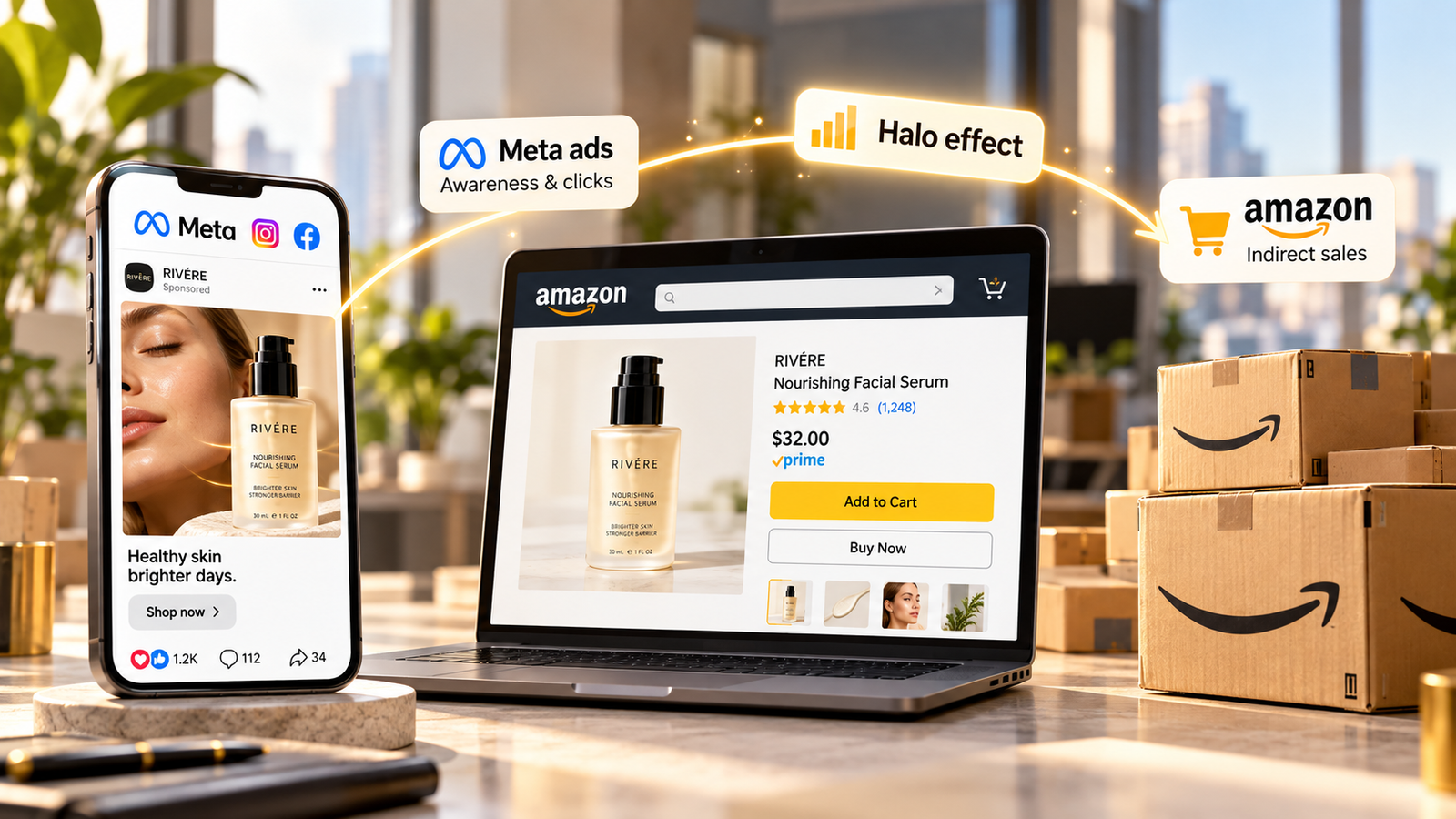
Her Meta ads had been doing two jobs. Some people who saw them bought on her website, which Meta could count. Many others saw the ad, opened the Amazon app because they had Prime, searched her brand name and bought there. Meta never saw those sales. Amazon gave the credit to its own ads and organic rank. The best-performing part of her marketing was invisible in every report she had, so she cut it.
A founder cuts Meta spend by 40% because website ROAS has dropped below target. Website revenue falls about 15%, roughly what was expected. Then, over the next six weeks, Amazon sales fall too, by more than anyone predicted. Nobody connects the two, because the Amazon dashboard and the Meta dashboard have never been in the same meeting.
That is the Amazon halo effect. If your product is sold on Amazon, a share of the people who see your ads will buy it there. This article shows how big the effect tends to be, how to measure it for your own brand, and how to decide where your ad traffic should go.
How big the halo usually is
The best public evidence comes from incrementality testing platforms that measure Amazon alongside DTC. Haus analysed hundreds of experiments from brands selling on both and reported that:
- 97% of experiments showed a positive lift in Amazon sales from DTC-focused campaigns.
- 83% produced a halo of at least 10%, meaning at least $0.10 in Amazon sales for every $1.00 spent on DTC ads.
- 16% drove more lift on Amazon than on the website the ads were built for.
- Social and video (Meta, TikTok, Snap, Pinterest, YouTube, connected TV) produced a much larger Amazon halo relative to DTC than search did: 7.9 times greater for social and 8.3 times for video.
The pattern makes sense. Search ads catch people who already decided to buy from you and send them to your site. Social and video ads create demand, and demand goes wherever the shopper prefers to buy.
| Channel type | Creates new demand? | Typical Amazon halo | Risk of judging on website ROAS alone |
|---|---|---|---|
| Paid social prospecting | Yes | Medium to high | Undervalued |
| YouTube and connected TV | Yes | High | Heavily undervalued |
| Influencer and podcast | Yes | Medium to high | Undervalued |
| Non-brand search | Partly | Low to medium | Roughly fair |
| Brand search | No, captures existing demand | Low | Overvalued |
| Retargeting | Rarely | Low | Overvalued |
Directional, based on published incrementality research and common patterns. Your own test is the only reliable number.
A dollar on Amazon is not a dollar on your website
Before you add Amazon halo to your ROAS, convert it to the same unit as everything else: contribution. Amazon takes a referral fee (15% in most categories) and, if you use FBA, a fulfilment fee per unit. Amazon raised US FBA fees by an average of about $0.08 per unit from January 15, 2026, after no increase in 2025. You also carry storage and inbound placement costs, and you usually do not get the customer's email.
| Line | Your website | Amazon (FBA) |
|---|---|---|
| Price paid by customer | $40.00 | $40.00 |
| Landed product cost | $10.00 | $10.00 |
| Referral fee (15%) | $0.00 | $6.00 |
| Fulfilment (3PL pick, pack, ship vs FBA fee) | $8.50 | $6.20 |
| Payment processing | $1.20 | Included |
| Storage and inbound placement (allocated) | $0.40 | $0.90 |
| Contribution before marketing | $19.90 | $16.90 |
| Customer email and repeat marketing | Yours | Not available |
Illustrative. FBA and referral fees vary by category, size and weight. Check your own fee preview.
Where a $40 sale goes before marketing, per unit (illustrative, from the table above)
Value the halo in contribution, not revenue. And the website sale also gives you the customer's email.
| Label | Landed product cost | Fees, fulfilment and storage | Contribution before marketing |
|---|---|---|---|
| Your website | $10 | $10.1 | $19.9 |
| Amazon (FBA) | $10 | $13.1 | $16.9 |
In this example, the ads looked like a loss on the website alone: $0.90 of contribution per dollar. With the Amazon halo included they return $1.11, before any repeat purchases. That is the difference between cutting the channel and keeping it.
How to measure your own halo
1. Geo test with Amazon in the outcome
The most reliable method is a geo holdout or scale test that measures total Shopify and Amazon sales by state. Switch a channel off (or up) in a set of states and compare with the rest. Amazon's business reports can be broken down by ship-to region with the right reports or tools. We walk through the method in Incrementality testing on a small budget.
2. Watch branded search on Amazon
If you are brand registered, Amazon Brand Analytics shows how often shoppers search your brand name on Amazon. Plot weekly branded search volume against weekly social and video spend. If brand searches rise and fall with spend, usually with a lag of a few days to two weeks, you are seeing the halo.
3. Use Amazon Attribution for ads that point to Amazon
When you run ads that link directly to your Amazon listing, Amazon Attribution tags let you see clicks, detail page views and purchases. Brand-registered sellers enrolled in the Brand Referral Bonus programme also earn a credit, on average around 10% of product sales, on eligible sales driven by that external traffic.
4. Check what happens when spend changes sharply
If you have ever paused or doubled a channel for a few weeks, look at Amazon organic sales around those dates. It is not a controlled test, but it often gives a first estimate.
Halo, cannibalisation or both?
Amazon can grow the brand, or it can simply move existing customers from your website to a channel where you earn less and cannot email them. Signs of each:
| Signal | Amazon is adding customers | Amazon is taking your customers |
|---|---|---|
| Total new customers (DTC plus Amazon) | Rising | Flat while Amazon grows |
| DTC repeat rate | Stable | Falling as Amazon grows |
| Amazon branded search share of Amazon sales | Stable or falling | Rising fast |
| Amazon ad sales from your own brand terms | A small share | A large share |
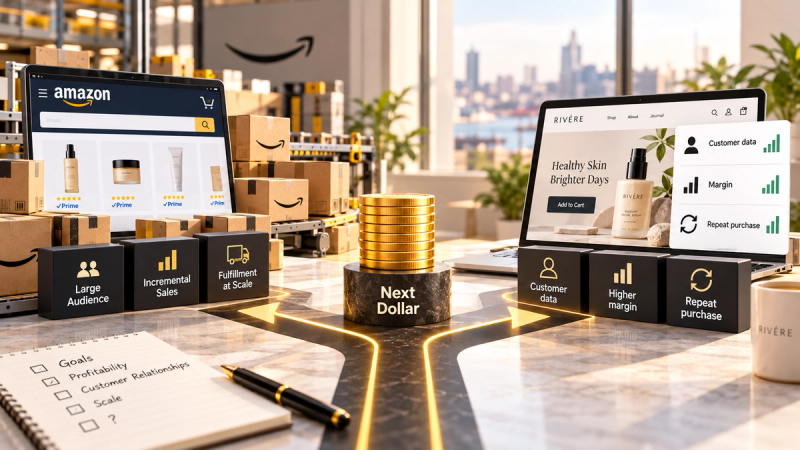
We cover the channel decision in more depth in Amazon or DTC: which channel deserves your next dollar.
Where should your ads send people?
There is no single right answer, but there is a sensible default:
- Send prospecting traffic to your website when you have a strong first-order offer, a product that leads to repeat purchases, and good conversion rates. You keep the customer and the data.
- Send traffic to Amazon for products where shoppers strongly prefer Prime delivery, where your website conversion rate is weak, or for low-priced single products where the website order barely covers shipping.
- Test a split. Run the same creative to both destinations in separate ad sets and compare combined contribution, including the Brand Referral Bonus and the value of the emails you capture on your site.
Illustrative cases
Cutting Meta cut Amazon twice as hard
- What the dashboard said
- Website ROAS on Meta had slipped to 1.6x against a 2.0x target. Spend was cut 40%.
- What was actually happening
- Website revenue fell 14%. Over the following six weeks, Amazon organic sales fell 22% and Amazon branded search volume fell by a similar amount. When the brand ran a geo test the following quarter, Meta's combined contribution per dollar, including Amazon, was about $1.25, comfortably profitable.
- Decision
- Scale Restore Meta spend in steps, judge it on combined website and Amazon contribution, and track Amazon branded search weekly next to Meta spend.
If your product sells on Amazon, a channel that looks weak on your website may be one of your strongest.
Sending all traffic to Amazon grew sales and emptied the email list
- What the dashboard said
- Moving Meta ads to point at the Amazon listing raised conversion rate and earned Brand Referral Bonus credits. Total sales rose 12%.
- What was actually happening
- Website new customers fell 70%. Email list growth nearly stopped, so the brand's second and third product launches reached far fewer existing customers. Repeat purchase revenue on the website started falling three months later.
- Decision
- Test Split prospecting 50/50 between website and Amazon destinations for eight weeks and compare combined contribution plus the value of captured subscribers.
Amazon can be the better destination for a sale and the worse destination for a customer. Count both.
What to do this week
- Put weekly Amazon sales and Amazon branded search volume next to weekly ad spend by channel for the last year.
- Calculate contribution per unit for your top products on the website and on Amazon.
- Check whether any report you use already adds Amazon sales to Meta or Google ROAS, and how.
- If you are brand registered, set up Amazon Attribution and enrol in the Brand Referral Bonus programme.
- Plan a geo test that measures Shopify and Amazon sales together for your largest social or video channel.
- Ask your CPA for a state nexus review that covers your FBA inventory locations.
Questions founders ask
Do Facebook and Instagram ads increase Amazon sales?
In most cases, yes. In Haus's analysis of hundreds of incrementality tests, 97% showed a positive lift in Amazon sales from DTC-focused campaigns, and social and video ads showed a much larger Amazon halo than search ads.
How do I measure the Amazon halo effect?
The most reliable method is a geo holdout or scale test that measures combined Shopify and Amazon sales by region. Supporting signals include Amazon branded search volume from Brand Analytics, Amazon Attribution data for ads that link to Amazon, and Amazon sales around past spend changes.
What is the Amazon Brand Referral Bonus?
A programme for brand-registered sellers that credits a bonus, on average around 10% of product sales, on eligible Amazon sales driven by your off-Amazon marketing and tracked with Amazon Attribution tags.
Should I send my Meta ads to Amazon or my website?
It depends on your website conversion rate, your first-order margin and how much repeat purchasing matters. Test both destinations with the same creative and compare combined contribution, including the value of the customer emails you capture on your own site.
Does Amazon FBA create state tax obligations?
It can. Amazon handles sales tax on Amazon orders in marketplace facilitator states, but inventory stored in a state can create a physical presence for income or franchise tax. California's tax appeals body has ruled that FBA sellers with inventory there owed its $800 minimum tax. Get a nexus review from a CPA.