- A snack brand at about $35K a month across Shopify and Amazon saw Amazon grow 60% in a quarter while DTC stayed flat. The plan was to shift budget to Amazon ads.
- Branded search made up a large share of Amazon ad sales, and Amazon growth was concentrated in regions where DTC repeat orders had dropped.
- 41% of new Amazon buyers came from regions where DTC already sold well. Total customers across both channels grew far less than Amazon alone suggested.
- After Amazon's referral and fulfilment fees, each Amazon order earned less than the DTC order it replaced, and the customer left the brand's email list.
- The decision: cut Amazon branded search to a defensive level, move the savings to DTC prospecting with a subscription offer, and report total new customers across both channels every month.
In this case study
The quarterly review had one headline: Amazon up 60%. The snack brand's Amazon agency presented it with charts, ranking improvements and a proposal to increase Amazon ad spend. DTC, meanwhile, was flat. The conclusion in the room was that Amazon was the growth channel, and the obvious next step was to move budget there.
Before moving anything, we added the two channels together. Total new customers across Shopify and Amazon had grown about 9% in the quarter. Not 60%. When we mapped where Amazon's new buyers were, a large share came from the same regions where the brand's DTC repeat orders had just dropped. Customers were not discovering the brand on Amazon. Many of them were existing DTC customers who had started buying on Amazon instead.
| Category | Better-for-you snacks |
|---|---|
| Size | About $35K a month in revenue across Shopify and Amazon |
| Channels | DTC run in-house on Meta; Amazon run by an agency |
| The question | Should budget move from DTC to Amazon ads? |
What the connected data showed
New customers per month by channel and in total (illustrative)
Illustrative composite. Some Amazon new-to-brand buyers had previously bought on the brand's website.
| Label | Total new customers | Amazon new-to-brand | DTC new customers |
|---|---|---|---|
| Month 1 | 1,500 | 600 | 900 |
| Month 2 | 1,540 | 720 | 820 |
| Month 3 | 1,590 | 840 | 750 |
| Month 4 | 1,635 | 960 | 675 |
Where a $30 order goes in each channel, before marketing (illustrative)
Amazon: 15% referral fee and FBA fee. DTC: shipping, pick and pack and payment fees.
| Label | Product cost | Fees, shipping and fulfilment | Contribution before marketing |
|---|---|---|---|
| DTC order | $9 | $8.2 | $12.8 |
| Amazon order | $9 | $10.1 | $10.9 |
The switch was mostly about convenience. Prime delivery was faster than the brand's own shipping, and customers' payment details were already saved on Amazon. Nothing was wrong with that choice from the customer's point of view. From the brand's point of view, each switched order earned less after fees, came with Amazon ad spend on top, and took the customer off the email list that drove most DTC repeat orders.
Why it was missed
Each channel looked healthy in its own dashboard, and each had its own owner. The Amazon agency reported Amazon. The founder reported DTC. Nobody's job was to add them together, so nobody saw that the growth on one side was largely coming from the other.
The decision
| Decision | What it meant in practice |
|---|---|
| Stop | Moving budget from DTC to Amazon on the strength of Amazon's growth alone. |
| Fix | Cut Amazon branded search to a defensive level and watch total brand sales, not channel sales. |
| Test | Move the savings to DTC prospecting with a subscription offer that matches Amazon's convenience. |
| Fix | Report total new customers and TACoS alongside ROAS every month, in one table for both channels. |
How to check this in your own business
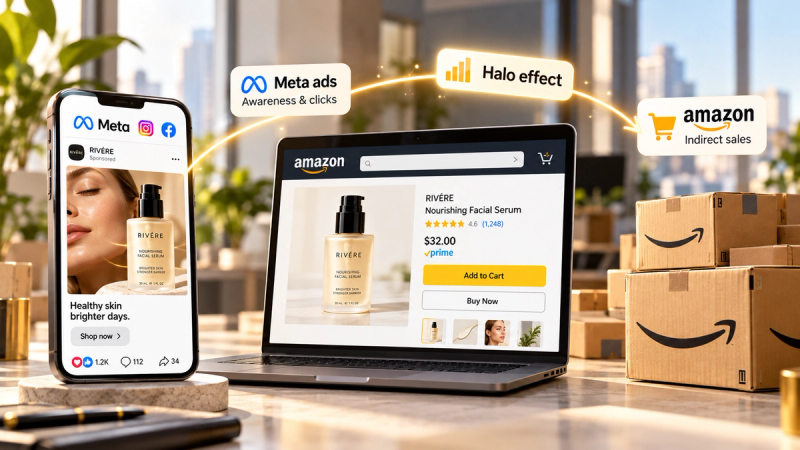
Build one monthly table with new customers from each channel and the total, plus the branded share of Amazon ad sales and DTC repeat orders by region. Our guide to Amazon vs DTC budget decisions explains the four numbers to compare, and the Amazon halo effect covers the other direction: Meta ads quietly selling on Amazon. A Blindspot Snapshot puts both channels in one view and tells you where the next dollar belongs.
Questions founders ask
How do I tell if Amazon is cannibalising my DTC sales?
Look at three things together: total new customers across both channels, DTC repeat orders in the regions where Amazon is growing, and the share of Amazon ad sales that come from searches for your brand name. If Amazon grows mostly on branded search while DTC repeat falls in the same regions, customers are switching rather than the brand growing.
Is Amazon cannibalisation always bad?
No. Some customers will only buy on Amazon, and losing them would be worse. The problem is paying Amazon ad spend and fees to move existing customers from a channel where you earn more and own the relationship.
Should I stop bidding on my brand name on Amazon?
Usually not entirely, because competitors can bid on it. Reduce branded bids to a defensive level for two weeks and watch total brand sales on Amazon. If they barely move, the extra spend was buying sales you already had.
Illustrative case: a composite built from patterns we see in brands at this stage, with details changed. It is not a single named client result.