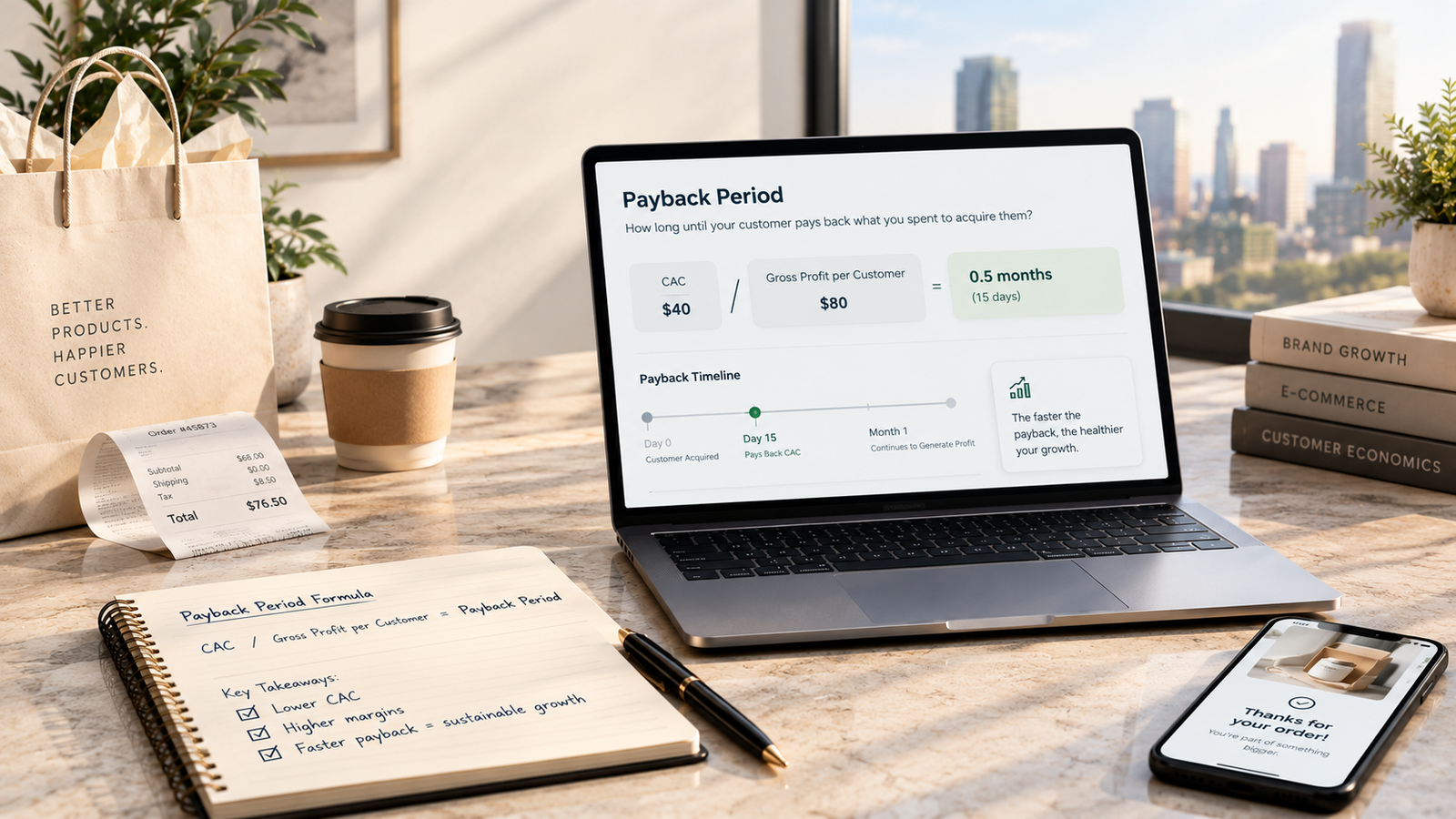
- CAC payback period is the number of months it takes for a new customer's cumulative contribution to cover what it cost to acquire them.
- Use contribution, not revenue. A customer can generate their CAC in revenue within a month and still take six months to pay it back in profit.
- Your payback target comes from cash, not from a benchmark. If cash for ads and inventory runs out in 90 days, a 180-day payback means you cannot fund your own growth.
- Payback differs by channel, offer and first product. The blended number hides the channel that pays back in two months and the one that never does.
- Shortening payback is usually cheaper than raising capital: higher first-order contribution, faster second orders, and less spend on customers who never return.
In this article
Two founders run brands with identical CAC: $60 per new customer. Both have healthy repeat rates. Both want to double ad spend in the fourth quarter. One of them does it comfortably. The other runs out of cash in November, has to pause ads during the most important weeks of the year, and cannot reorder her best-selling product.
The difference was not CAC or LTV. It was time. The first brand's customers paid back their $60 in about two months, through a strong first order and a fast second one. The second brand's customers took seven months. Same cost, same eventual value, completely different ability to grow. That gap has a name: CAC payback period.
What CAC payback period measures
It sits between CAC and LTV and connects them to the one thing that limits growth: cash. Every dollar spent on acquisition is cash that leaves today and comes back slowly. The longer payback takes, the more cash is tied up in customers who have not paid you back yet, and the less you have for the next customer, the next inventory order, and the next month.
A worked example: same CAC, different clocks
| Brand A (coffee) | Brand B (premium skincare) | |
|---|---|---|
| CAC | $60 | $60 |
| First order contribution | $32 | $18 |
| Median days to second order | 28 | 75 |
| Cumulative contribution per customer at month 2 | $63 | $24 |
| Payback month | Month 2 | Month 7 |
| 12-month contribution per customer | $118 | $124 |
Cumulative contribution per customer minus $60 CAC, by month since first order (illustrative)
| Label | Brand A (coffee) | Brand B (skincare) |
|---|---|---|
| M0 | -$28 | -$42 |
| M1 | -$12 | -$40 |
| M2 | $3 | -$36 |
| M3 | $13 | -$26 |
| M4 | $22 | -$20 |
| M5 | $30 | -$13 |
| M6 | $37 | -$6 |
| M7 | $43 | $2 |
| M8 | $48 | $9 |
On an LTV-to-CAC ratio, the two brands look almost identical. On payback, they are different businesses. Brand A can spend aggressively, because the money comes back before the next month's bills. Brand B has to fund seven months of every new customer before seeing a return, so every increase in ad spend becomes a cash problem first.
Why payback must be measured in contribution
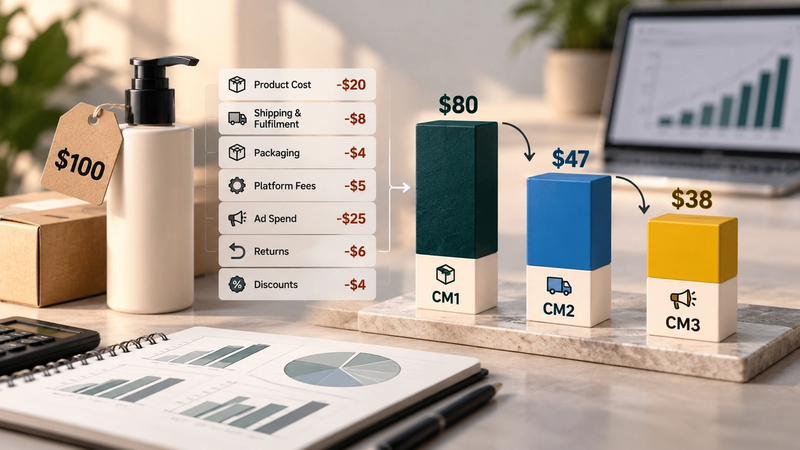
The most common mistake is measuring payback in revenue. A customer who spends $60 in their first month has "paid back" a $60 CAC in revenue, but if half that revenue went on product and shipping, you have recovered $30. Using revenue makes payback look two to three times faster than it is.
Months to pay back a $60 CAC for Brand B, measured three ways
| Label | Months to payback |
|---|---|
| Revenue | 2 |
| Gross margin | 4 |
| Contribution (CM2) | 7 |
If you have not calculated contribution margin per order yet, start with our guide to CM1, CM2 and CM3.
Set your payback target from cash, not a benchmark
Founders often ask what a "good" payback period is. The honest answer is: whatever your cash can fund. A brand with $500,000 in the bank and no inventory deposits due can wait longer than a brand with $80,000 and a supplier who wants 50% upfront 90 days before goods ship.
| Situation | Sensible payback target | Why |
|---|---|---|
| Bootstrapped, inventory paid upfront | First order to 3 months | Ad spend and stock compete for the same cash |
| Bootstrapped with good supplier terms | 3 to 6 months | Supplier credit funds part of the gap |
| Funded, consumable or subscription | 6 to 12 months | Capital is there to fund the gap, and repeat is predictable |
| Durable or one-time product | First order | There is little repeat to rely on |
Payback is different for every channel and offer
A blended payback period averages fast channels with slow ones and hides the ones that never pay back. In our cohort analysis guide, a supplements brand found that full-price Google Search customers paid back in month three, Meta in month four, and Black Friday and influencer-code customers had not paid back after six months. The cheapest channels on day one were the slowest to return cash.
Months for cumulative contribution to cover CAC (illustrative supplements brand)
The last two had not paid back within six months; nine and twelve are projections from their repeat curves.
| Label | Payback month |
|---|---|
| Google Search, full price | 3 |
| Meta, full price | 4 |
| Influencer, 30% code | 9 |
| Black Friday, 40% off | 12 |
Four ways to shorten payback without raising money
- Raise first-order contribution. Bundles and starter kits lift order value; a smarter free shipping threshold stops subsidising small orders; a gift instead of a percentage discount protects margin.
- Pull the second order forward. Time the reorder email to just before the median second-order date, with the product customers most often buy next.
- Lead with the right product. Your gateway product brings customers who come back sooner.
- Stop paying for customers who never return. Cut spend on the channels and offers whose cohorts have not paid back in a full year.
Same CAC, seven months apart
- What the dashboard said
- CAC of $60 and a 12-month LTV that looked healthy at more than twice CAC. The plan was to double spend for the holidays.
- What was actually happening
- Contribution payback was seven months, because the first order carried a 20% code and the second order arrived at a median of 75 days. Doubling spend would have tied up an extra $140K in unrecovered CAC by January.
- Decision
- Fix Replace the welcome code with a gift, launch a routine starter kit as the lead offer, move the reorder email to day 55, and scale spend only as fast as cash allowed.
LTV tells you whether a customer is worth acquiring. Payback tells you whether you can afford to.
Payback by channel, offer and first product is one of the core views in a Blindspot Snapshot, because it decides how fast a brand can safely grow.
Questions founders ask
How do you calculate CAC payback period?
Group new customers by the month they were acquired. Track cumulative contribution per customer (revenue minus product, fulfilment, shipping, fees, discounts and returns) month by month. The payback period is the first month in which cumulative contribution per customer exceeds the CAC for that group.
What is a good CAC payback period for ecommerce?
For most bootstrapped or lightly funded DTC brands, three to six months is a workable range, and payback on the first order is ideal. Subscription and high-repeat brands can tolerate longer payback if they have the cash. The right target is the one your cash cycle can fund.
Is payback better than LTV to CAC ratio?
For budget decisions, usually yes. LTV is a forecast that is easy to inflate and takes a long time to verify. Payback is based on what customers have actually spent, and it tells you when the cash comes back, which is what limits how fast you can grow.
Why does payback get longer as I scale?
Because each extra dollar of ad spend usually buys customers at a higher marginal CAC, and those customers are often slightly less likely to come back. Payback on the last dollar is longer than payback on the average dollar. Measure it after each spend increase.