- A women's strength gear brand at about $20K a month ran almost all its Meta spend behind one ad for one hero product, at a 2.4x ROAS.
- About one in five Shopify orders already included a bundle, bought without any ad promoting it.
- Bundle orders carried 38% more contribution after shipping, and bundle buyers were more likely to return for accessories.
- The decision: launch the bundle as a second ad offer with a fair share of budget for three weeks and compare contribution per order, before testing any new products.
- With one live ad, there was nothing in the account to compare against. The signal was sitting in Shopify, not in Ads Manager.
In this case study
The ad account was simple, and the founder liked it that way. One ad. One product: the hero lifting gear set that made the brand's name. A steady 2.4x ROAS. Every time someone suggested testing something new, the answer was the same: why touch what works? The plan for growth was to raise the budget on the one ad, or to launch new products and advertise those.
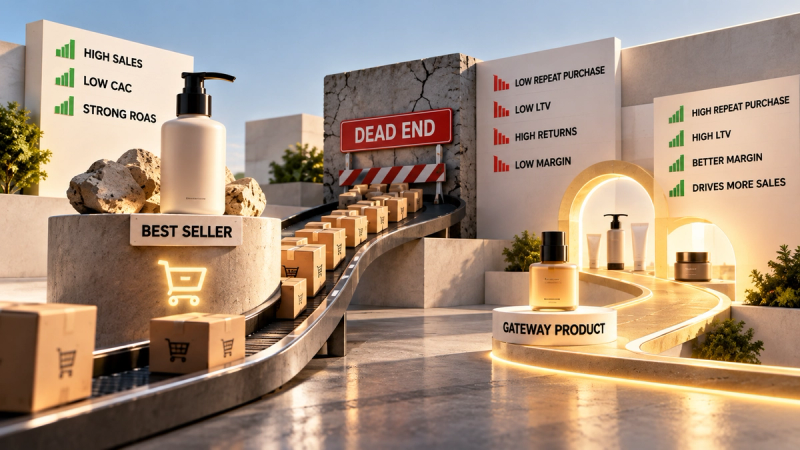
Before launching anything new, we looked at what customers were already choosing. About one order in five included a bundle: the hero set plus accessories, sold at a small saving. No ad promoted it. Customers found it on the site and added it themselves. And those orders were earning noticeably more than the single-product orders the ad was selling.
| Category | Women's strength training gear |
|---|---|
| Size | About $20K a month in revenue |
| Ads | One live Meta ad for one hero product, 2.4x ROAS |
| The question | Should we raise spend on the winning ad, or launch new products? |
What the connected data showed
Contribution per order after product cost, shipping and fees (illustrative)
Shipping and fulfilment cost barely changes between the two orders, so most of the extra revenue drops through to contribution.
| Label | Contribution per order |
|---|---|
| Hero product only | $26 |
| Bundle (hero plus accessories) | $35.9 |
Share of customers who bought again within 90 days, by first order type (illustrative)
| Label | 90-day repeat rate |
|---|---|
| Hero product only | 14% |
| Bundle | 23% |
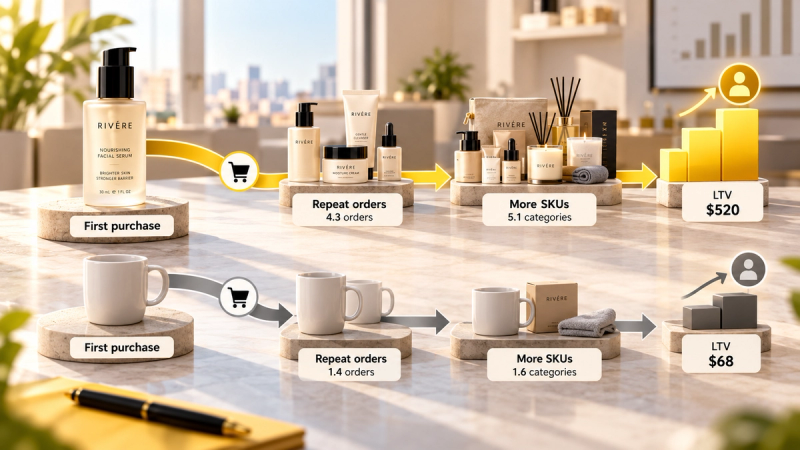
Two things were happening. On each order, the bundle spread the fixed costs of picking, packing and shipping over more product, so more of the revenue was left as contribution. And over time, bundle buyers had already started using the accessories, so they came back for refills and add-ons more often. The bundle was a better first purchase on both counts, and the brand was not advertising it at all.
Why it was missed
With one live ad, there was no comparison in the account. Ads Manager can only tell you how an ad performs relative to the others you run, and there were no others. The bundle signal was sitting in Shopify orders, not in Ads Manager, and nobody was looking at order composition alongside ad results.
There is also a 2026-specific reason this matters. Meta's delivery now relies heavily on the creative to decide who sees an ad. A single ad for a single product reaches one kind of buyer and saturates that pocket over time. A second offer, built around a different reason to buy, opens a second pocket. Adding an offer is often a better way to grow than adding budget.
The decision
| Decision | What it meant in practice |
|---|---|
| Test | Launch the bundle as a second ad offer, with a fair share of budget, for three weeks. |
| Fix | Compare the two ads on contribution per order and new customers from Shopify, not only on ROAS. |
| Stop | Raising spend on the single ad, and launching new products, until the bundle test has read. |
How to check this in your own business
- Export 90 days of orders with line items. Find the product combinations that appear most often.
- Calculate contribution per order for single-item orders and for each common combination.
- Check 90-day repeat for customers whose first order was each combination.
Related reading: finding your gateway product and ranking ads by profit per click. A Blindspot Snapshot reads your orders and ads together and shows which offers deserve budget.
Questions founders ask
Why does running one ad for one product limit growth?
Meta's delivery now leans heavily on the creative to find the right audience. One ad for one product reaches one slice of buyers and eventually saturates it. It also gives you nothing to compare against, so you cannot see which offers earn more.
How do I know if a bundle should be an ad offer?
Look at orders that already include it without being advertised. If a meaningful share of orders contain the bundle, and those orders earn more contribution after shipping and repeat more, it deserves a fair test as a lead offer.
Should I judge the bundle ad on ROAS?
Next to contribution per order. A bundle ad can show a similar or slightly lower ROAS than a single-product ad and still earn more per order, because shipping and fulfilment costs are spread over more product.
Illustrative case: a composite built from patterns we see in brands at this stage, with details changed. It is not a single named client result.